Description
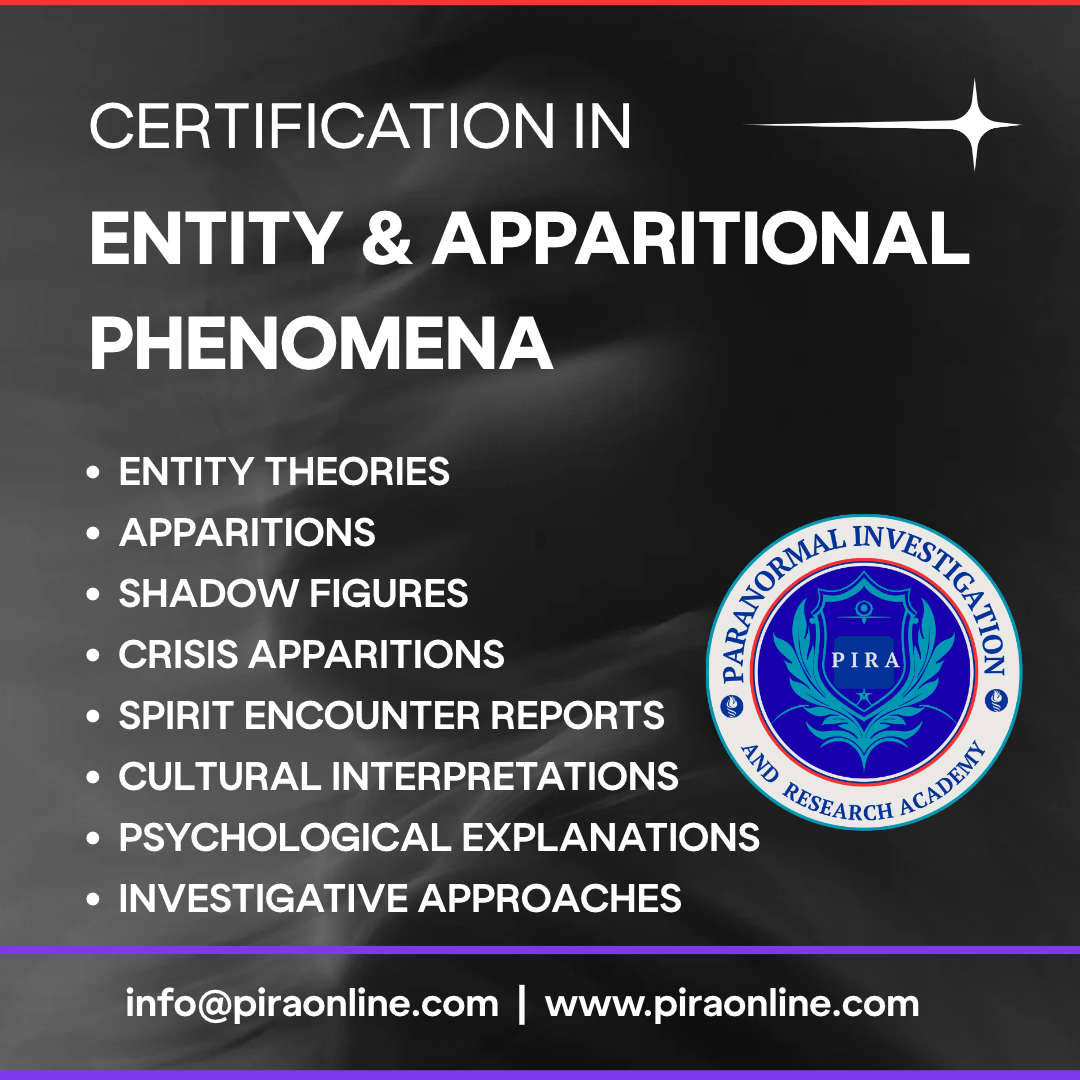
Certificate in Entity and Apparitional Phenomena
Professional Certificate Course in Paranormal Research and Apparition Investigation
Explore Unusual Encounters. Investigate Apparition Reports. Develop Professional Research Skills.
Have you ever wondered why people report seeing mysterious figures, sensing an unseen presence, hearing unexplained voices, or experiencing encounters with individuals who may have passed away?
Why do some people describe seeing shadow figures in their homes? Why do certain experiences occur during sleep, grief, or moments of crisis? Why do witnesses from different cultures interpret similar experiences in completely different ways? And most importantly, how can these reports be investigated systematically rather than accepted or dismissed without examination?
The Certificate in Entity and Apparitional Phenomena is designed for curious learners, aspiring paranormal investigators, parapsychology students, and anyone interested in developing a deeper understanding of reported encounters with entities, apparitions, shadow figures, and other unusual experiences.
This course takes you beyond ghost stories and popular paranormal entertainment. You will explore the subject through investigative methods, witness interviews, psychological and perceptual research, environmental testing, historical and cultural perspectives, evidence documentation, and structured case analysis.
Whether your interest comes from personal experiences, a fascination with unexplained phenomena, or a desire to develop practical investigation skills, this course provides a structured learning journey into one of the most intriguing areas of paranormal studies.
What Makes This Course Different?
Many paranormal discussions begin with a conclusion: a ghost appeared, a spirit communicated, or an unexplained event must have a supernatural cause.
Responsible investigation begins with a different question: What exactly happened, what evidence is available, and which explanations deserve further examination?
Throughout this course, you will learn to approach unusual reports with curiosity, open-mindedness, and critical thinking. You will examine different theories without being required to accept any single explanation as fact.
You will learn to distinguish between what a witness directly experienced, how the witness interpreted that experience, what can be independently verified, and what remains uncertain.
This approach allows you to investigate unusual experiences without automatically dismissing witnesses or prematurely declaring that a supernatural explanation has been established.
The result is a more thoughtful, evidence-conscious approach to entity and apparition research.
What Will You Learn?
By completing this course, you will develop knowledge and practical skills in the following areas:
- Understanding entity reports, apparitions, felt presences, shadow figures, and other reported encounters.
- Exploring major theories concerning entities and apparitional phenomena.
- Classifying visual, auditory, tactile, and multisensory apparition experiences.
- Investigating shadow figures and ambiguous human-shaped forms.
- Examining crisis apparition reports and experiences associated with death or serious illness.
- Conducting structured interviews with people who report unusual encounters.
- Documenting witness statements and comparing multiple accounts.
- Understanding cultural, religious, historical, and folklore-based interpretations.
- Evaluating psychological, perceptual, sleep-related, and memory-based explanations.
- Investigating environmental factors such as lighting, reflections, sound, temperature, and air movement.
- Using photography, video, audio recordings, and environmental measurements responsibly.
- Preserving original records and organizing evidence for later review.
- Comparing competing hypotheses and identifying information that supports or challenges them.
- Preparing professional case reports and structured investigation records.
- Developing a complete investigation from an initial report to a reasoned conclusion.
Your Complete 13-Module Learning Journey
Introduction — Understanding Entity and Apparitional Phenomena
Begin by exploring the field of entity and apparition research and learning why unusual experiences require careful investigation. Understand the difference between seeing something, sensing something, interpreting something, believing something, and demonstrating a claim.
You will establish the investigation framework used throughout the course: experience, documentation, verification, alternative explanations, pattern analysis, hypothesis development, and further testing.
Module 1 — Foundations of Entity and Apparitional Research
Build a strong foundation in the language, concepts, and principles of apparition investigation.
Explore different categories of reported encounters, including apparent human figures, shadow figures, felt presences, recurring apparitions, location-associated experiences, and encounters involving deceased individuals.
Learn to separate direct observations from assumptions, develop precise investigative terminology, and transform a personal story into a neutral, researchable case report.
Module 2 — Major Theories of Entities
Examine the major explanatory approaches used to understand reported entity encounters.
Explore the survival hypothesis, psychological and perceptual explanations, environmental influences, cultural interpretations, memory-related explanations, and the possibility that some reports remain unexplained.
Learn to compare competing hypotheses, identify supporting and contradictory observations, and determine what additional evidence would be needed to evaluate each explanation.
Module 3 — Apparitions: Phenomenology and Classification
Discover how apparition reports can be classified according to the actual experience described by the witness.
Study full-body figures, partial apparitions, faces, indistinct forms, voices, footsteps, unexplained smells, tactile sensations, and the feeling that someone is present without being visible.
Learn to document the appearance, movement, duration, sensory characteristics, emotional response, and circumstances of an encounter. You will also develop an Apparition Phenomenology Form for structured case documentation.
Module 4 — Shadow Figures and Ambiguous Human Forms
Investigate reports of dark human-shaped figures, hooded silhouettes, peripheral shadows, and rapidly moving forms.
Explore the roles of low-light conditions, peripheral vision, contrast, moving light sources, architectural features, reflections, and sleep-related experiences.
Learn how to map a location, reconstruct viewing conditions, test different lighting arrangements, compare witness descriptions, and conduct controlled observations.
Your practical assignment is to develop a Shadow Figure Replication Experiment that examines whether a reported visual effect can be reproduced under similar conditions.
Module 5 — Crisis Apparitions and Experiences Around Death
Examine reports in which a person appears to have been seen or sensed around the time of another person’s death, serious illness, or crisis.
Learn why accurate timelines and independently recorded information are essential when evaluating these reports.
Explore coincidence, selection effects, retrospective reconstruction, and the difference between information recorded before an event became known and details recalled afterward.
You will practice building a crisis-apparition timeline and identifying which parts of a case are independently verified, based on later testimony, or still uncertain.
Module 6 — Spirit Encounter Reports and Witness Investigation
Learn how to investigate the human side of an unusual encounter.
Develop practical skills in non-leading interviews, witness timelines, memory assessment, consent procedures, follow-up questioning, and the comparison of multiple accounts.
Discover how leading questions, repeated storytelling, social influence, and information shared between witnesses can affect the details of a report.
Your practical exercise is to conduct a simulated witness interview and prepare a structured case file containing the witness account, timeline, observations, corroboration checklist, and follow-up questions.
Module 7 — Cultural, Religious, and Historical Interpretations
Explore how societies throughout history have understood encounters with spirits, ancestors, ghosts, jinn, demons, guardians, and other unseen beings.
Examine the influence of religion, folklore, family beliefs, community expectations, and cultural ideas about death on the interpretation of unusual experiences.
You will also study experiences involving deceased loved ones, including sensed presences, dreams, visual encounters, and other reported experiences associated with bereavement.
Learn to respect the personal and cultural meaning of an experience while distinguishing spiritual interpretations from conclusions that can be established through empirical investigation.
Module 8 — Psychological and Perceptual Explanations
Develop a deeper understanding of how perception, attention, expectation, sleep, emotion, and memory can influence unusual experiences.
Explore ambiguous visual stimuli, pattern recognition, confirmation bias, sleep paralysis, experiences during transitions between sleep and wakefulness, sleep deprivation, grief, stress, and memory reconstruction.
Learn how to investigate these possibilities without automatically dismissing the witness or assuming that an unusual experience indicates mental illness.
Your practical assignment is to prepare a psychological alternative-explanation analysis of an apparition case, identifying relevant factors and unanswered questions.
Module 9 — Environmental and Physical Investigation
Move from witness accounts to the physical environment in which an experience occurred.
Learn to map rooms and buildings, document light sources, examine reflective surfaces, investigate background sounds, and assess possible contributions from ventilation, plumbing, traffic, structural movement, and other environmental conditions.
Discover how to use appropriate environmental measurements, reconstruct reported visual or auditory effects, and conduct controlled replication attempts.
You will prepare a Site Investigation Report containing a site map, photographs, observations, measurements, controlled tests, possible explanations, and unresolved findings.
Module 10 — Evidence Collection, Documentation, and Technology
Learn how to use common investigation equipment and digital recording tools without treating every unusual image, sound, or measurement as evidence of paranormal activity.
Explore photography, video recording, audio capture, background noise, reflections, motion blur, lens artifacts, recording limitations, and environmental context.
Understand the importance of original files, accurate timestamps, continuous recording where appropriate, equipment documentation, and careful handling of digital evidence.
Develop a responsible approach to evaluating unexplained recordings and distinguishing what the technology actually captured from what an investigator believes it represents.
Module 11 — Evidence Analysis, Verification, and Alternative Explanations
Bring together the information gathered during interviews, site inspections, environmental testing, and digital recording.
Learn to assess the reliability of witness testimony, examine inconsistencies, compare independent accounts, evaluate the quality of recordings, and identify possible sources of error.
Develop skills in hypothesis comparison, evidence classification, information verification, and recognizing the difference between a lack of explanation and evidence supporting a particular explanation.
Practice evaluating a case by identifying established observations, plausible explanations, contradictory information, and questions that require further investigation.
Module 12 — Professional Case Management, Ethics, and Investigation Standards
Discover how to organize an investigation from the initial report through final documentation.
Learn about informed consent, witness privacy, confidentiality, respectful interviewing, accurate reporting, secure recordkeeping, evidence preservation, and transparent communication of uncertainty.
Explore responsible investigation practices for private homes, historic locations, public sites, and other settings where permission and safety are essential.
Understand why investigators should avoid exploiting vulnerable witnesses, making unsupported claims, trespassing, contaminating evidence, or presenting personal interpretations as established facts.
Develop a professional approach to planning investigations, maintaining case records, communicating findings, and identifying the limits of your conclusions.
Module 13 — Entity and Apparitional Phenomena Research Mastery and Capstone Investigation
Bring together the knowledge and skills developed throughout the course in a comprehensive case investigation project.
You will select a suitable hypothetical, publicly documented, or ethically collected case and develop a structured investigation covering the original report, witness accounts, chronology, environmental conditions, alternative explanations, available evidence, and unresolved questions.
Learn to construct a hypothesis comparison, identify evidence gaps, explain investigative limitations, and prepare a clear final report.
The capstone project is designed to demonstrate your ability to approach an unusual encounter systematically, document observations accurately, evaluate competing explanations, and communicate conclusions responsibly.
Conclusion — Developing a Responsible Approach to Entity Research
Complete your learning journey by reviewing the principles of careful observation, critical thinking, ethical investigation, and evidence-based reasoning.
Understand how to continue developing your research skills, improve your case documentation, and approach future reports with curiosity while remaining honest about what the available evidence can and cannot establish.
Who Is This Course For?
The Certificate in Entity and Apparitional Phenomena is suitable for:
- People fascinated by ghosts, apparitions, shadow figures, and unexplained encounters.
- Aspiring paranormal investigators who want a structured foundation in case research.
- Students interested in parapsychology and anomalous experiences.
- Paranormal enthusiasts who want to move beyond storytelling and develop investigation skills.
- Researchers interested in eyewitness testimony, unusual perceptions, and reports associated with deceased individuals.
- Content creators, writers, and documentary enthusiasts who want a more systematic understanding of apparition reports.
- Existing paranormal investigators who want to improve their interviewing, documentation, and evidence-evaluation practices.
- Learners interested in the relationship between psychology, perception, culture, and reported paranormal experiences.
No assumption that entities or apparitions have a proven supernatural cause is required. The course is designed to help learners investigate reports thoughtfully and evaluate the evidence available.
Practical Skills You Can Develop
This is more than a collection of theories about unexplained phenomena. The course emphasizes practical exercises that help you apply your learning to realistic investigation scenarios.
Depending on the case and available resources, you will practice:
Witness investigation: Prepare neutral interview questions, reconstruct timelines, and compare independent accounts.
Apparition classification: Record the sensory characteristics, duration, movement, location, and circumstances of a reported encounter.
Shadow figure analysis: Examine lighting, viewing angles, reflections, and other possible explanations for ambiguous visual experiences.
Case chronology: Organize the sequence of an alleged crisis apparition and distinguish contemporary records from later recollections.
Environmental inspection: Document site conditions, investigate possible sound and light sources, and conduct controlled replication tests.
Digital evidence review: Examine photographs, video, and audio recordings while considering technical artifacts and recording limitations.
Hypothesis evaluation: Compare possible explanations, identify supporting and contradictory observations, and determine which questions remain unanswered.
Professional reporting: Prepare structured investigation records and communicate findings without exaggeration or unsupported certainty.
These practical activities are designed to build transferable research and documentation skills that can be used when studying unusual experiences.
Why Study Entity and Apparitional Phenomena?
Reports of apparitions and perceived presences raise fascinating questions about human perception, consciousness, memory, culture, and the interpretation of unusual events.
For some people, the subject is connected to personal experiences. Others are interested in the historical and cultural traditions surrounding apparitions. Some want to learn how paranormal cases are investigated, while others are curious about the psychological and environmental factors that may contribute to these reports.
This course brings these interests together in a structured educational program.
Rather than relying on sensational claims, you will learn how to ask better questions, record information accurately, consider different perspectives, and examine evidence before reaching conclusions.
You will also learn an important principle: an experience can be personally meaningful without its cause being conclusively established. This is particularly relevant when studying experiences associated with grief, sleep, and encounters with deceased loved ones.
What Makes a Responsible Paranormal Investigator?
A responsible investigator does not need to begin with absolute belief or absolute disbelief.
Instead, the investigator learns to:
- Ask questions without suggesting the answers.
- Listen to witnesses without ridiculing their experiences.
- Record what happened before interpreting it.
- Consider ordinary explanations alongside more unusual hypotheses.
- Distinguish personal conviction from independently verifiable evidence.
- Preserve original records and document investigative procedures.
- Recognize uncertainty and acknowledge limitations.
- Avoid exaggerating findings to make a case appear more mysterious.
- Respect the privacy, dignity, and safety of everyone involved.
These principles are central to the course and help distinguish systematic investigation from speculation.
Your Learning Outcomes
By the end of the program, you should be better prepared to:
- Explain the principal concepts and terminology used in entity and apparition research.
- Classify reported experiences according to their observable and reported characteristics.
- Compare major theories concerning the possible origins of unusual encounters.
- Conduct structured, non-leading interviews with witnesses.
- Assess timelines, recollections, and independent corroboration.
- Investigate psychological, perceptual, cultural, and environmental factors.
- Document site conditions and conduct appropriate controlled observations.
- Review photographic, video, audio, and other investigative records critically.
- Organize case files and evaluate competing explanations.
- Prepare a structured case investigation report with clear findings and limitations.
These learning outcomes describe the educational skills the program is designed to develop. They do not imply that completing the course proves the existence of entities or establishes professional licensing in a regulated occupation.
Frequently Asked Questions
1. What is the Certificate in Entity and Apparitional Phenomena?
It is an educational course focused on the investigation and research of reported entity encounters, apparitions, shadow figures, felt presences, and related unusual experiences. It combines theoretical study with practical case documentation, witness investigation, environmental assessment, and evidence evaluation.
2. Will I learn how to investigate reported ghost encounters?
Yes. You will learn how to document reports, interview witnesses, examine locations, investigate environmental conditions, review recordings, compare explanations, and prepare structured case reports.
3. Does the course assume that ghosts and spirits exist?
No. The course examines reported experiences and competing explanations without treating any particular supernatural interpretation as established fact. Students learn to distinguish the experience itself from claims about its cause.
4. Will I learn about shadow figures and mysterious human-shaped forms?
Yes. A dedicated module explores shadow figure reports, ambiguous visual perception, peripheral vision, lighting conditions, reflections, architectural causes, and sleep-related experiences.
5. Does the course cover experiences involving deceased loved ones?
Yes. The program examines bereavement-related experiences, crisis apparition reports, cultural interpretations, witness timelines, and the challenges of independently verifying information associated with such experiences.
6. Will I learn to use paranormal investigation equipment?
You will study responsible uses of photography, video, audio recording, and appropriate environmental measurement tools. The emphasis is on understanding what equipment can document, its limitations, and why an unusual reading or recording does not automatically demonstrate a paranormal cause.
7. Is this course suitable for beginners?
Yes. The course begins with foundational concepts and progressively develops practical investigation and evidence-evaluation skills. A previous qualification in psychology or paranormal studies is not assumed by the course outline.
8. Can I use the knowledge for my own paranormal investigations?
The course is designed to help you plan and document investigations more systematically. Any real-world investigation should be conducted with appropriate permission, respect for privacy, attention to safety, and honest reporting of findings.
9. Will this course qualify me as a licensed psychologist or therapist?
No. This is an educational program in entity and apparitional research. It does not provide a psychology, psychotherapy, or clinical practice license, and it should not be represented as a substitute for any legally required professional qualification.
10. What is the capstone investigation?
The final module brings the course together through a structured investigation project. You will organize a case, assess witness accounts, consider environmental and psychological explanations, evaluate available evidence, identify uncertainties, and prepare a final report.
11. What will I be able to do after completing the course?
You should have a stronger foundation for documenting apparition reports, interviewing witnesses, examining potential explanations, organizing evidence, and preparing structured case studies. Further experience and study may be useful for learners who want to pursue more advanced research.
12. Who issues the certificate?
The certificate is issued according to the policies of the educational provider offering the program. Learners should review the provider’s accreditation status, certificate terms, and any applicable recognition arrangements before enrolling. A course certificate should not be confused with government accreditation or professional licensing unless such recognition is independently established.
Begin Your Journey into Entity and Apparitional Research
What should you do when someone reports seeing a figure that should not have been there? How should you investigate a voice heard in an apparently empty room? What can be learned from a recurring shadow figure, a sensed presence, or a report associated with the death of a loved one?
The most useful starting point is not an immediate conclusion. It is a careful investigation.
The Certificate in Entity and Apparitional Phenomena gives you a structured opportunity to explore these questions, understand different interpretations, develop practical research skills, and learn how to evaluate unusual reports with greater confidence and care.
Study the theories. Examine the experiences. Investigate the environment. Question the evidence. Document your findings.
Enroll in the Certificate in Entity and Apparitional Phenomena and begin developing your knowledge of paranormal research, apparition investigation, and anomalous experience analysis.
Your journey into the investigation of unexplained encounters starts with one essential question:
What happened, what can be verified, and what remains to be discovered?
Reviews
There are no reviews yet.