
Description
Extrasensory Perception (ESP)
The Complete Practical Course in Telepathy, Clairvoyance, Precognition, Remote Viewing, and ESP Research
Explore the fascinating world of extrasensory perception, learn how to conduct structured ESP experiments, and develop practical skills for investigating extraordinary claims with an open mind and an evidence-based approach.
Can information ever appear to arrive before it is consciously perceived? Why do some people report knowing who is calling before answering the phone? Can dreams seem to anticipate future events? What happens when someone attempts to describe a hidden image without seeing it? And how can we distinguish an extraordinary experience from coincidence, intuition, imagination, or selective memory?
These questions have fascinated researchers and curious minds for generations.
Welcome to the Extrasensory Perception (ESP) — Complete 21-Module Course, a comprehensive educational program designed to help you explore reported psychic phenomena through practical exercises, controlled experiments, historical research, observation techniques, and systematic analysis.
This course goes far beyond simply reading stories about psychic experiences. You will learn how ESP researchers structure experiments, select hidden targets, document impressions, evaluate predictions, examine dream experiences, analyze remote-viewing sessions, and compare results against chance expectations.
You will also discover why accurate recordkeeping, independent judging, blind testing, and honest reporting are essential when investigating claims that challenge conventional explanations.
Whether you are fascinated by telepathy, curious about precognition, interested in remote viewing, or looking for a structured way to explore the relationship between consciousness and extraordinary experiences, this course offers a practical starting point.
You do not need previous research experience or expensive laboratory equipment to begin. You need curiosity, patience, and a willingness to investigate what your results actually show.
What Is Extrasensory Perception?
Extrasensory perception, commonly known as ESP, refers to proposed ways of obtaining information without relying on ordinary sensory channels.
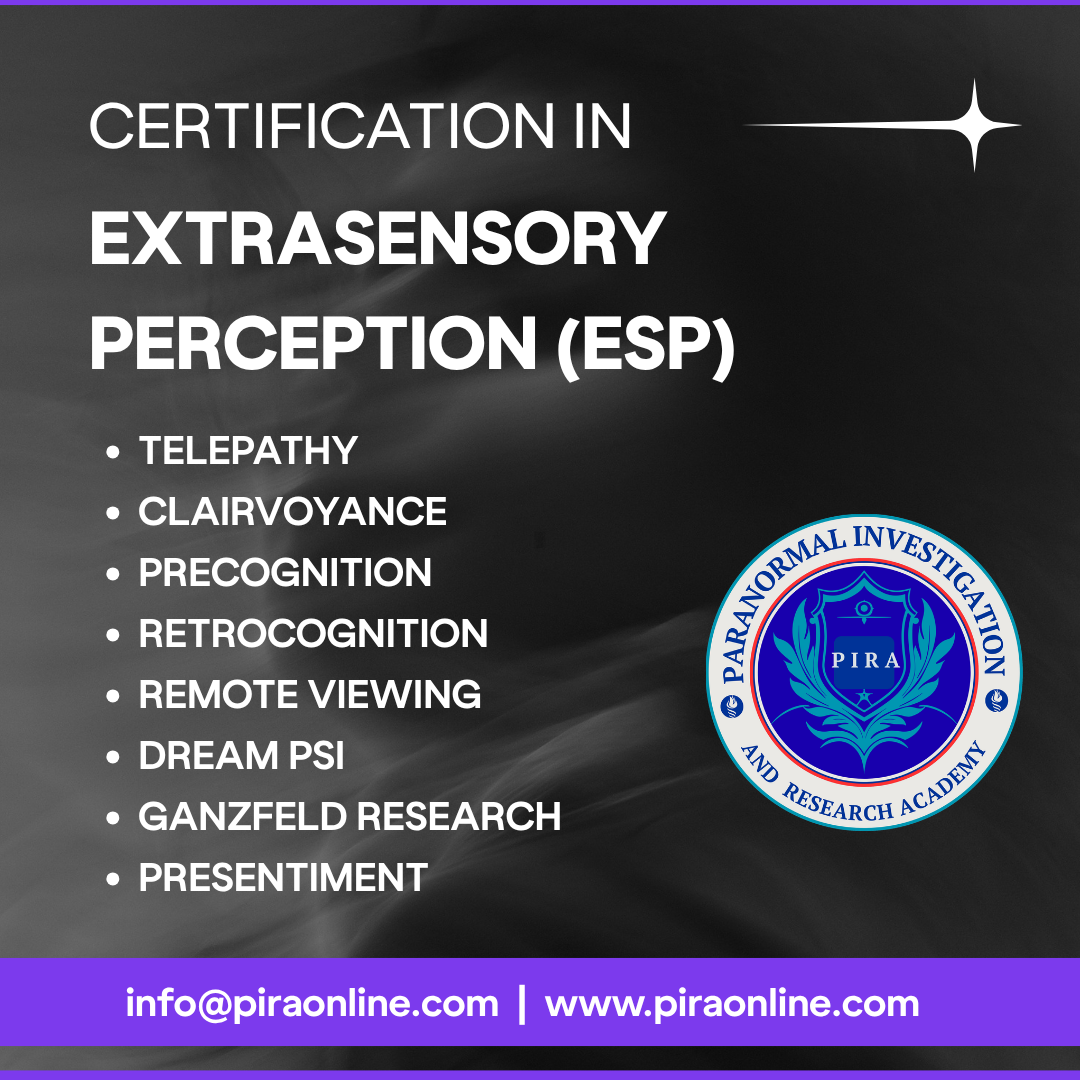
The subject includes several major categories:
- Telepathy: Reported information transfer between minds without ordinary communication.
- Clairvoyance: Claims of obtaining information about hidden or distant targets.
- Precognition: Experiences or impressions that appear to relate to future events.
- Retrocognition: Claims of obtaining information about past events that was not acquired through ordinary means.
- Remote viewing: Structured attempts to describe a hidden or distant target.
- Dream psi: Reports of dreams containing information that appears to correspond with an unknown target or later event.
- Presentiment: Research examining whether physiological responses appear to precede randomly selected future stimuli.
These subjects raise intriguing questions about perception, memory, consciousness, and the limits of human knowledge.
However, studying ESP does not mean assuming that psychic abilities have been established. ESP research remains scientifically controversial, and findings across different experimental approaches have been debated. Some analyses report small statistical effects in particular paradigms, while concerns about methodology, replication, bias, and alternative explanations remain important.
That is what makes this course valuable: you will explore the subject while learning how to evaluate claims rather than simply accepting or rejecting them.
You will develop a practical framework for asking better questions, recording observations before outcomes are known, and distinguishing a compelling experience from evidence that can withstand careful examination.
Why Choose This ESP Course?
Many people interested in ESP try exercises, make predictions, or explore remote viewing and dream experiences. But without a consistent method, it is difficult to know whether a result is meaningful or whether it reflects coincidence, memory, expectation, or flexible interpretation.
This course teaches you how to move from informal experimentation toward structured investigation.
What Makes This Training Different?
- A complete exploration of ESP: Study the major ESP categories, their historical development, and the research approaches used to investigate them.
- Practical experiments: Work with hidden images, concealed objects, random targets, prediction journals, dream records, and remote-viewing exercises.
- Structured training programs: Develop your skills through progressive practice rather than relying on isolated demonstrations.
- Controlled testing methods: Learn about randomization, blind procedures, target concealment, independent judging, and predefined scoring rules.
- Dream and intuition research: Explore dream recall, intuitive impressions, precognitive claims, and ways to document experiences before their outcomes are known.
- Research and statistical skills: Learn how to record hits and misses, compare results with chance expectations, and understand the difference between statistical significance and practical importance.
- Critical-thinking development: Identify confirmation bias, imagination contamination, expectation effects, selective memory, and other sources of error.
- A personal ESP research practice: Build a research journal, organize your data, develop your own protocols, and work toward a substantial final project.
The central principle throughout the course is simple: do not change the rules to make a result look successful. Record the experience first, examine the outcome afterward, and let the evidence guide your interpretation.
What You Will Learn
By completing this course, you will develop a broad understanding of ESP research and practical methods for investigating reported anomalous experiences.
You will learn how to:
- Understand the meaning, history, and major categories of extrasensory perception.
- Distinguish telepathy, clairvoyance, precognition, retrocognition, remote viewing, dream psi, and presentiment.
- Develop observation skills and recognize the influence of attention, expectation, and memory.
- Create a personal ESP journal and maintain consistent research records.
- Conduct structured image-based telepathy exercises.
- Investigate hidden-target claims using concealed objects, photographs, and randomized targets.
- Design precognition experiments in which predictions are recorded before future targets are selected.
- Explore retrocognition through blind historical-target exercises.
- Conduct structured remote-viewing sessions and evaluate target descriptions.
- Maintain a dream journal and participate in controlled dream-target exercises.
- Understand the principles behind Ganzfeld research and presentiment studies.
- Compare intuition with reported ESP experiences.
- Explore the influence of relaxation, meditation, attention, and altered states on experimental conditions.
- Design experiments with clearly defined variables and predefined scoring procedures.
- Understand randomness, target selection, chance expectations, and target similarity.
- Record hits, misses, confidence ratings, and unsuccessful trials.
- Interpret basic statistical results and recognize common analysis errors.
- Compare results across different ESP methods.
- Conduct extended practice projects and organize the findings into a final research report.
These skills can help you investigate ESP claims more systematically, understand the challenges researchers face, and develop a foundation for continued study.
Explore the Complete 21-Module Curriculum
Introduction: Entering the World of ESP
Begin your journey by understanding what extrasensory perception means, how it differs from ordinary perception, and why researchers have studied reported psychic experiences for more than a century.
You will explore the main ESP categories, the difference between personal experiences and controlled experimental evidence, and why extraordinary experiences can feel convincing even when their causes remain uncertain.
You will also learn the importance of ethical boundaries and why ESP exercises should never replace reliable methods for medical, legal, financial, or safety-critical decisions.
Practical activity: Create your Personal ESP Research Baseline. Record your expectations, rate your current belief in ESP, document relevant previous experiences, identify your preferred research area, and commit to recording unsuccessful results alongside apparent successes.
Module 1: Foundations of Extrasensory Perception
Discover the fundamental concepts, terminology, and history of ESP research.
Explore telepathy, clairvoyance, precognition, retrocognition, remote viewing, dream psi, and presentiment. Learn about early psychical research, forced-choice experiments, free-response methods, Ganzfeld studies, remote-viewing programs, and contemporary research approaches.
You will also learn how anecdotes, case reports, controlled experiments, replication, meta-analysis, effect sizes, statistical significance, and publication bias differ in their contribution to evaluating evidence.
Practical exercise: Develop a research mindset by creating a prediction-recording system that preserves every trial and uses consistent evaluation rules.
Module 2: Developing the ESP Observer
Before conducting ESP experiments, you need a reliable way to observe and record your impressions.
This module focuses on attention, sensory awareness, observation without immediate interpretation, and the distinction between an initial impression and an explanation created afterward.
You will explore confirmation bias, coincidence, guessing, wishful thinking, pattern completion, and memory contamination. Learn how to record visual impressions, sounds, bodily sensations, imagery, emotional responses, and spontaneous associations without automatically labeling them as psychic information.
Practical exercise: Complete an initial series of target trials and develop a standardized ESP journal containing target identification, timestamps, confidence ratings, impressions, outcomes, and scores.
Module 3: Telepathy
Can one person identify information associated with another person’s mind without receiving it through ordinary communication?
This module examines telepathy as a research claim and introduces the sender-receiver experimental structure.
You will learn about target selection, isolation, randomization, response recording, and scoring. You will also examine how facial expressions, body language, voice changes, prior knowledge, and shared experiences can create the impression of telepathic communication.
Progress from simple image-based exercises to more structured trials involving randomized targets and blind procedures.
Practical exercise: Complete a progressive telepathy training program, moving from beginner trials to an extended experiment while recording hits, misses, accuracy, and confidence.
Module 4: Clairvoyance
Clairvoyance research focuses on claims of obtaining information about hidden or distant targets without ordinary access to the relevant information.
This module introduces concealed photographs, sealed envelopes, hidden objects, and randomly selected locations as possible experimental targets.
You will learn to describe a target using specific characteristics such as shape, color, texture, movement, spatial arrangement, and environmental features rather than forcing an immediate guess.
The module also explores blind target selection, independent judging, similarity scoring, and the importance of distinguishing detailed matches from vague descriptions that could fit many possible targets.
Practical exercise: Conduct a 30-trial hidden-target experiment and compare your descriptions, confidence levels, accuracy, and expected chance performance.
Module 5: Precognition
Precognition involves claims of obtaining information about future events before they occur.
The timing of a prediction is particularly important. If a prediction is recorded only after an outcome is known, it becomes difficult to determine whether the original impression genuinely anticipated the event.
This module teaches you to timestamp predictions before future targets are selected, use random images or numbers, define scoring rules in advance, and compare results with appropriate chance expectations.
You will explore both forced-choice predictions and open-ended impressions, while learning why flexible interpretations can make almost any outcome appear meaningful after the fact.
Practical exercise: Complete a structured precognition project involving 50 predictions, predefined scoring criteria, confidence ratings, and a report that includes every trial.
Module 6: Retrocognition
Retrocognition refers to claims of obtaining information about past events that was not acquired through ordinary means.
In this module, you will explore blind historical-target exercises using photographs, locations, objects, and other records from the past.
You will also examine the differences between retrocognition and ordinary memory, including cryptomnesia, forgotten information, reconstruction, and accidental exposure to target details.
Learn to separate specific descriptions from generic similarities and identify details that contradict the proposed target.
Practical exercise: Complete a blind historical-target experiment and assess correct details, incorrect details, generic impressions, and plausible alternative explanations.
Module 7: Remote Viewing
Remote viewing is a structured approach to attempting to describe a distant or hidden target without first seeing it.
This module introduces a repeatable session format that includes preparation, target identification, initial impressions, sensory descriptions, spatial relationships, sketching, summary, target reveal, and scoring.
You will learn how to use a remote-viewing data sheet to record visual, auditory, tactile, temperature, movement, texture, and geometric impressions.
You will also explore blind judging, decoy targets, target ranking, similarity scoring, and analytical overlay—the process in which interpretation begins to replace the original observation.
Practical exercise: Complete a progressive 30-session remote-viewing challenge and calculate your overall performance instead of selecting only your most impressive sessions.
Module 8: Dream Psi
Dreams can contain vivid images, emotions, places, and narratives. Some people report that particular dreams appear to correspond with unknown information or later events.
This module explores dream psi claims, dream recall, dream telepathy, precognitive dreams, and the difficulties involved in studying dreams systematically.
You will learn to record dreams immediately after waking, preserve original notes, use timestamps, and compare dream reports with targets selected under controlled conditions.
You will also examine how symbolism, selective matching, memory reconstruction, and vague descriptions can create apparent correspondences.
Practical exercise: Begin a 30-day dream psi laboratory with daily dream records, target trials, confidence ratings, matching results, unsuccessful trials, and unexpected details.
Module 9: Ganzfeld Research
Ganzfeld research is an important example of how a proposed ESP effect can be investigated using a structured experimental method.
You will explore the basic concept of sensory homogenization, relaxed attention, free-response perception, and the use of target pools and decoy targets.
Learn about session preparation, consistent environmental conditions, target isolation, experimenter blinding, recording impressions, and independent judging.
You will also examine why published Ganzfeld findings have generated scientific disagreement and how researchers assess methodological quality, replication, and alternative explanations.
Practical exercise: Develop or participate in a small, appropriately supervised Ganzfeld-style study and compare its methods and results with published research.
Module 10: Presentiment
Presentiment research examines whether physiological or behavioral responses appear to occur before randomly selected future stimuli.
This module introduces the distinction between consciously predicting an event and measuring a possible anticipatory response.
Explore measurements such as heart rate, skin conductance, breathing, and, in advanced research settings, EEG. Learn why randomization, precise timing, baseline conditions, equipment reliability, and predefined analysis procedures matter.
You will also examine how statistical fluctuation, timing artifacts, multiple comparisons, expectation effects, and equipment problems can influence apparent findings.
Practical exercise: Design a basic presentiment-style experiment plan that specifies the baseline, stimulus-selection method, timing, measurements, and evaluation criteria.
Module 11: Intuition vs ESP
Not every accurate impression requires an extraordinary explanation.
Intuition can reflect rapid judgment, unconscious processing, emotional information, and the recognition of patterns learned through experience. ESP claims, by contrast, propose information acquisition beyond ordinary sensory channels.
This module helps you compare these possibilities through structured prediction exercises.
You will learn to record intuitive impressions before outcomes are known, assess confidence against actual accuracy, and investigate whether certain types of predictions perform differently from others.
Practical exercise: Create a personal prediction profile showing your strongest and weakest categories, confidence accuracy, common errors, and possible cognitive biases.
Module 12: Consciousness, Attention, and Altered States
The conditions under which an experience occurs may influence what a person notices, remembers, and reports.
This module explores conscious awareness, unconscious processing, attention, relaxation, meditation, and hypnagogic experiences during the transition toward sleep.
You will learn how to compare observations made under different conditions while avoiding the assumption that a vivid or unusual experience must have a paranormal origin.
The module also emphasizes responsible self-observation and the importance of stopping any exercise that causes discomfort or distress.
Practical exercise: Develop a state-dependent ESP journal that records the method, duration, attention state, experience, confidence, and results of each session.
Module 13: Designing ESP Experiments
A useful experiment should be designed to test a question, not protect a preferred conclusion.
This module teaches you how to turn broad questions into measurable research questions, identify variables, define control conditions, and establish a repeatable procedure.
You will explore single-blind and double-blind methods, automated randomization, independent judging, and preregistration.
Learn how to specify the number of trials, target-selection process, scoring rules, exclusion criteria, and statistical analysis before collecting data.
Practical exercise: Write a complete ESP experimental protocol that another person could follow and evaluate.
Module 14: Randomness, Targets, and Chance
An unusual result may seem impressive, but its meaning depends on how targets were selected and how likely the result was to occur by chance.
This module explores random selection, pseudorandom number generation, target balancing, target pools, and the importance of choosing targets that are sufficiently distinct.
You will learn about hit rates, expected distributions, random fluctuations, and the dangers of using predictable target sequences.
Practical exercise: Build and test your own ESP target database, including a documented selection procedure and criteria for target quality.
Module 15: Recording, Scoring, and Statistical Evaluation
Reliable research requires reliable records.
This module teaches you how to build standardized trial records, calculate hit rates and percentage accuracy, work with rankings and average scores, and understand basic statistical evaluation.
You will explore effect sizes and why statistical significance does not automatically establish a meaningful or practically useful effect.
You will also learn about multiple testing, retrospective editing, selective reporting, and the importance of preserving original records.
Practical exercise: Create a complete ESP scoring and data-integrity system that records successes, failures, confidence levels, original impressions, and final outcomes.
Module 16: ESP Training Laboratory
Bring your developing skills together in a structured laboratory-style learning environment.
You will establish consistent procedures for timing, target selection, recording, scoring, and independent verification.
Explore telepathy exercises involving sender-receiver separation, clairvoyance exercises using hidden targets, and precognition exercises in which predictions are made before target selection.
You will then compare results across different methods using a consistent scoring framework.
Practical exercise: Conduct a series of structured ESP trials and prepare a comparative report covering methods, results, errors, and limitations.
Module 17: Advanced Remote Perception Experiments
Move beyond introductory remote-viewing exercises and develop a more detailed method for recording and evaluating target impressions.
This module introduces coordinate-based target identification, sensory decomposition, spatial sketching, geometric descriptions, blind judging, and aggregate scoring.
You will learn to distinguish raw impressions from interpretations and to recognize when a description becomes increasingly specific only after the target has been revealed.
Practical exercise: Complete a 20-session blind remote-viewing project, obtain independent judgments where possible, analyze errors, and prepare a written report.
Module 18: Dream, Telepathy, and Precognition Laboratory
This module combines several major ESP research approaches in a practical comparative program.
You will explore dream-telepathy procedures involving concealed targets, receiver isolation, dream recording, and blind judging. You will also learn how to timestamp dream reports before comparing them with later events.
Compare normal dream records, target-based dream exercises, waking ESP trials, remote-viewing sessions, and precognition experiments using consistent documentation principles.
Practical exercise: Build a personal dream psi dataset that records apparent matches, partial matches, generic similarities, contradictions, and unsuccessful trials.
Module 19: Research Replication and Scientific Skepticism
A result becomes more informative when the method is transparent enough for other people to repeat.
This module explores replication, independent evaluation, research skepticism, and the challenges involved in interpreting extraordinary findings.
You will learn why one successful session is not enough to establish a reliable ability, why failed replications matter, and how publication bias can influence the apparent strength of a research field.
You will also examine the difference between being open to a possibility and accepting a claim without adequate evidence.
Practical exercise: Review an ESP study or published experimental claim and develop a replication plan that identifies its method, potential weaknesses, and criteria for evaluating the outcome.
Module 20: Building an ESP Research Practice
Turn your learning into a consistent personal research system.
You will establish your research priorities, create a schedule for practice, organize target materials, maintain a digital or paper archive, and track progress over time.
Learn to review results across multiple sessions, identify recurring errors, preserve unsuccessful trials, and decide when a method needs improvement or when the available data do not support a conclusion.
Practical exercise: Create your personal ESP research manual, including your chosen methods, standardized forms, data-storage procedures, ethical guidelines, and review schedule.
Module 21: Capstone ESP Research Project
The final module brings together the skills developed throughout the course.
You will select a research question, choose an appropriate experimental approach, establish a procedure, collect and preserve data, analyze results, and prepare a final report.
Your project should explain the question being investigated, the method used, the target-selection procedure, the scoring criteria, the results, and the limitations.
You will also reflect on alternative explanations and identify what additional research would be needed to support stronger conclusions.
Final project: Complete a structured ESP research report that demonstrates your ability to plan, document, evaluate, and communicate an investigation responsibly.
Course Conclusion: Continue Exploring ESP Through Research
Finish the course with a practical framework for continuing your exploration of extrasensory perception.
You will review the major ESP categories, reflect on your research experience, and establish a plan for future experiments, reading, and personal development.
The goal is not to finish with a predetermined answer about ESP. It is to develop the skills to ask meaningful questions, test them carefully, document the results, and understand what those results can reasonably tell you.
What Practical Projects Will You Complete?
Throughout the course, you will develop a collection of research tools and practical outputs that can support future learning.
Depending on your chosen activities, these may include:
- A Personal ESP Research Baseline.
- A standardized ESP observation journal.
- Telepathy experiment records.
- Hidden-target and clairvoyance worksheets.
- Timestamped precognition prediction logs.
- Blind historical-target evaluation forms.
- Remote-viewing session sheets and target sketches.
- A dream journal and dream-target experiment records.
- A Ganzfeld study plan.
- A presentiment experiment design.
- An intuition and confidence profile.
- An altered-state observation journal.
- A complete experimental protocol.
- A randomized target database.
- An ESP scoring and data-integrity system.
- A comparative ESP laboratory report.
- An advanced remote-viewing project report.
- A replication assessment.
- A personal ESP research manual.
- A final capstone research report.
These practical outputs give you a way to apply what you learn instead of relying entirely on memory or informal impressions.
Who Is This Course For?
This course is designed for people who want to explore ESP and anomalous cognition through a combination of subject knowledge and practical investigation.
It may be particularly suitable for:
- ESP and psychic phenomena enthusiasts who want a structured introduction to the major ESP categories.
- Aspiring independent researchers who want to develop experimental skills and maintain organized research records.
- Remote-viewing enthusiasts who want to practice blind target sessions and evaluate their results systematically.
- Dream and intuition enthusiasts who want to record impressions and compare them with outcomes using predefined criteria.
- Paranormal investigators who want to explore ESP-related claims with greater methodological care.
- Students of consciousness and perception who are interested in unusual experiences and the challenges of studying them.
- Writers and content creators who want a deeper understanding of ESP research, experimental design, and scientific controversies.
- Curious beginners who want to explore extraordinary claims without being required to accept a particular belief system.
No previous laboratory experience is required. You can begin with simple materials and gradually develop more structured projects as your understanding grows.
What Makes This Course Different?
Many introductions to ESP focus primarily on stories, historical personalities, famous experiments, or instructions for practicing a particular technique.
This course combines exploration with an emphasis on how the claims can be evaluated.
You will not only learn what telepathy, clairvoyance, precognition, and remote viewing are supposed to involve. You will also learn how to structure a trial, select targets, record impressions before feedback, use independent judging, preserve unsuccessful results, and compare findings with chance expectations.
You will explore both intriguing reports and the methodological problems that make ESP research difficult.
You will learn why a good result deserves careful examination rather than immediate celebration, why a failed experiment can be informative, and why a reliable conclusion should reflect the full dataset rather than a selection of impressive examples.
This makes the course suitable for learners who want to explore ESP while developing practical research habits that extend beyond the subject itself.
What Could You Do With the Knowledge You Gain?
Completing this course can help you build a foundation for continued learning and appropriate independent projects involving ESP and anomalous experiences.
Develop a personal ESP research practice. Conduct structured exercises, maintain records, and review your results over time.
Create educational content. Develop articles, presentations, videos, or podcasts explaining ESP categories, famous experiments, and the challenges of interpreting results.
Build a research portfolio. Organize your experimental protocols, remote-viewing sessions, dream studies, and capstone report into a documented collection of work.
Participate in research communities. Share methods and discuss findings with other learners or researchers who value transparent documentation and constructive review.
Explore specialist interests. Continue studying remote viewing, dream psi, telepathy, precognition, or other areas introduced in the curriculum.
Develop research and analytical skills. Apply structured observation, experimental design, data recording, and critical evaluation to other questions that interest you.
The course does not guarantee psychic abilities, employment, income, or recognition as a professional researcher. Further study, experience, and additional qualifications may be necessary for particular career pathways.
Frequently Asked Questions
1. What is ESP in simple terms?
ESP stands for extrasensory perception. It refers to proposed forms of information acquisition beyond ordinary sensory channels. Commonly discussed categories include telepathy, clairvoyance, precognition, and related phenomena.
2. Is this course suitable for beginners?
Yes. It begins with the foundations of ESP and gradually introduces observation, experimental design, target selection, scoring, and more advanced research projects.
3. Will I learn practical ESP exercises?
Yes. The course includes structured activities involving hidden targets, image-based trials, predictions, remote-viewing sessions, dream records, and other experimental approaches.
4. Will this course guarantee that I develop psychic abilities?
No. The course teaches you about ESP claims and how to investigate them. It does not guarantee the development of psychic abilities, and reliable paranormal abilities have not been established as scientifically proven capabilities.
5. Do I need special equipment?
No expensive equipment is required for many of the basic activities. Paper records, a journal, images, concealed targets, and suitable random-selection methods can support numerous exercises. Some advanced research approaches may use additional tools.
6. Will I learn remote viewing?
Yes. You will explore remote-viewing session structure, sensory descriptions, target sketches, blind judging, scoring, and progressive practice sessions.
7. Does the course include dream psi?
Yes. You will study dream recall, timestamped dream reports, dream-target experiments, possible precognitive dream claims, and methods for distinguishing specific matches from vague or retrospective interpretations.
8. Will I learn about Ganzfeld and presentiment research?
Yes. The course introduces the principles of both approaches, their experimental procedures, important methodological considerations, and the controversies surrounding the interpretation and replication of their findings.
9. Is this course scientifically based?
The course teaches research methods and critical evaluation, including experimental controls, randomization, blinding, statistical interpretation, and replication. It also examines the controversies and limitations in ESP research. This does not mean that ESP itself has been established as a reliable scientific phenomenon.
10. What is the capstone project?
You will develop and document a research project based on a specific question. You will define the procedure, collect results, evaluate the findings, consider alternative explanations, and prepare a final written report.
11. Can I use ESP to make important life decisions?
ESP exercises should not be used as substitutes for reliable evidence or qualified advice in medical, legal, financial, or safety-critical matters. The course is educational and investigative.
12. Does completing the course make me a licensed ESP researcher?
The course provides educational training. It does not automatically confer a university degree, government licence, or legally regulated professional status. Review the course provider’s certification terms for details about any certificate offered.
Your ESP Research Journey Starts Here
Extrasensory perception raises fascinating questions about the relationship between consciousness, perception, intuition, and information.
The Extrasensory Perception (ESP) — Complete 21-Module Course gives you a structured opportunity to explore these questions through comprehensive lessons, practical exercises, progressive training programs, and a final research project.
Study telepathy, clairvoyance, precognition, retrocognition, remote viewing, dream psi, Ganzfeld research, and presentiment. Learn how to create controlled experiments, preserve original impressions, evaluate target matches, analyze results, and recognize the limitations of your findings.
Build your own research journal, develop practical investigation skills, and create a personal framework for continuing your exploration.
You do not have to begin as an expert. You simply need the curiosity to ask questions and the discipline to examine the answers carefully.
Enrol today and begin your journey into the fascinating world of extrasensory perception and practical ESP research.
Educational disclaimer: This course explores reported ESP phenomena, historical accounts, experimental methods, and research controversies. ESP remains scientifically disputed, and the course does not promise the development of psychic abilities or establish paranormal claims as fact. Course completion does not replace accredited academic education, regulated professional qualifications, or medical, legal, financial, or mental health services.
Reviews
There are no reviews yet.