Description
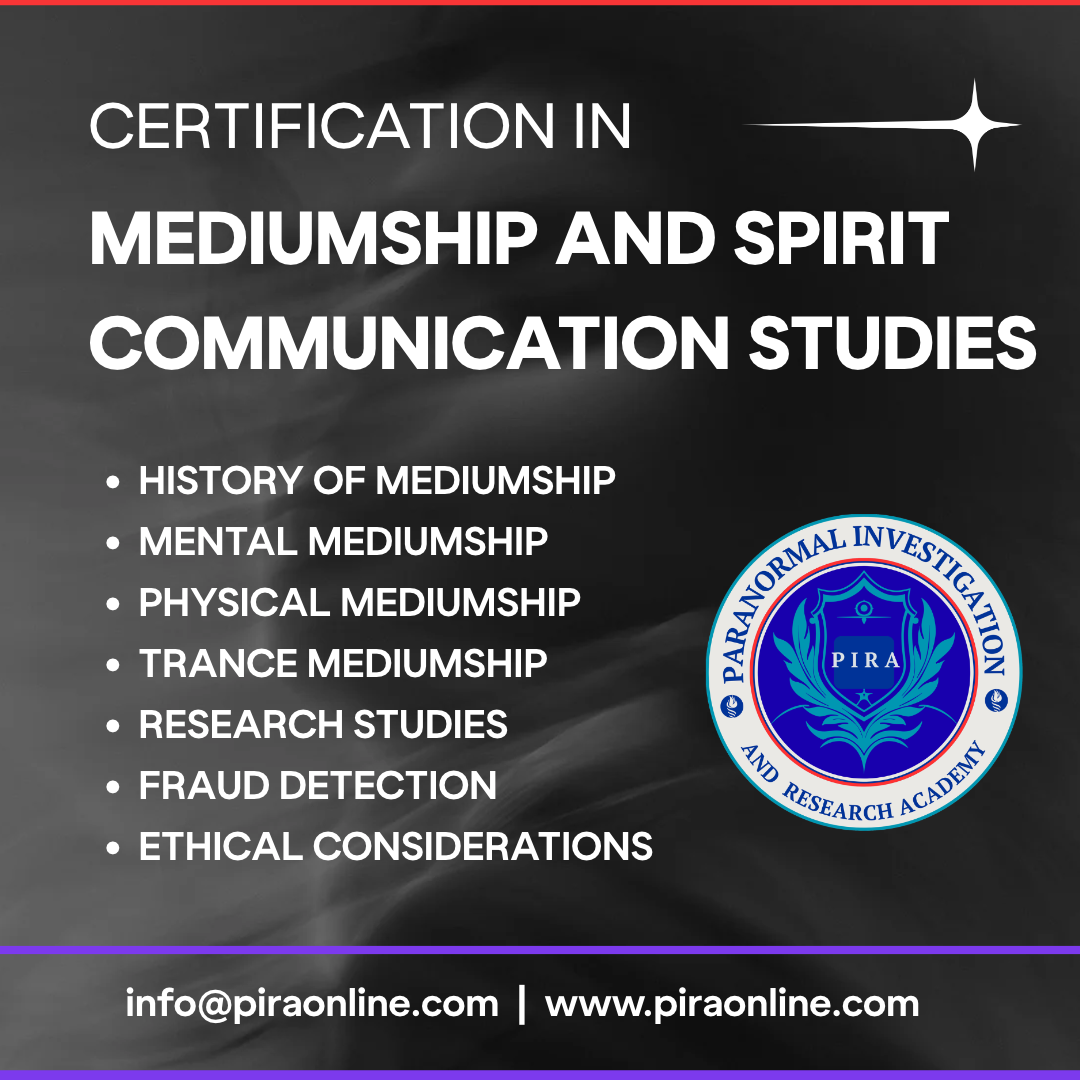
Certificate in Mediumship and Spirit Communication Studies
Explore the History, Psychology, Research Methods, and Evidence Behind Mediumship
Discover one of the most fascinating and debated subjects in human history: the possibility of communication between the living and the deceased.
The Certificate in Mediumship and Spirit Communication Studies is a comprehensive educational program designed for learners who want to explore mediumship beyond stories, assumptions, and personal beliefs. You will study historical cases, different forms of mediumship, séance phenomena, trance experiences, spirit communication theories, psychological explanations, research experiments, fraud detection, and ethical practice.
Rather than asking you to accept a particular explanation, this course teaches you how to investigate claims carefully, evaluate information objectively, and distinguish personal experiences from conclusions supported by evidence.
Whether your interest is spiritual, historical, psychological, investigative, or research-oriented, this course provides a structured introduction to the many dimensions of mediumship and spirit communication.
What Is Mediumship and Spirit Communication Studies?
Mediumship is a broad term used for practices in which individuals claim to receive information or communication from deceased people or other spiritual sources. These practices have appeared in different forms across cultures and historical periods.
Some mediums report receiving names, memories, images, emotions, or personal details. Others describe trance states, automatic writing, apparent spirit voices, unexplained sounds, or physical phenomena during séances.
But how should these experiences be understood?
Are they spiritual communications, psychological experiences, examples of unconscious information processing, cases of coincidence, deliberate deception, or something that remains unexplained?
These questions have attracted the attention of historians, psychologists, philosophers, investigators, and researchers for generations.
This course introduces you to the major questions surrounding mediumship and gives you practical methods for examining them. You will learn how to document claims, assess the accuracy of statements, recognize possible information leakage, evaluate alternative explanations, and understand the strengths and limitations of historical and modern research.
You do not need to enter the course as a believer or a skeptic. You need curiosity, an open mind, and a willingness to examine evidence honestly.
Why Enroll in This Course?
Explore a Fascinating and Unusual Field
Go beyond basic introductions to paranormal subjects. Study the history of Spiritualism, famous mediums, mental and physical mediumship, trance experiences, channeling, séance phenomena, and the development of psychical research.
Learn to Investigate Rather Than Assume
A compelling story is not automatically proof, and an unusual experience should not automatically be dismissed. Learn how to separate what was reported, what was observed, what was verified, and what remains uncertain.
Understand the Psychology Behind Mediumship
Explore how perception, memory, suggestion, expectation, emotional experiences, pattern recognition, and social interaction can influence the way people interpret mediumship sessions.
Study Historical Cases and Research
Examine influential investigations involving well-known mediums and learn why researchers have disagreed about the interpretation of certain findings. Understand how research methods and experimental controls affect the strength of conclusions.
Develop Practical Investigation Skills
Learn to prepare session records, classify statements, preserve original recordings, identify potential information leakage, create evidence assessment systems, and design structured research proposals.
Understand Fraud Detection
Study methods through which misleading demonstrations can occur, including cold reading, prior information gathering, misdirection, concealed equipment, selective reporting, and other possible sources of error.
Build Stronger Critical-Thinking Skills
Learn to consider competing explanations, recognize confirmation bias, preserve unsuccessful statements, question assumptions, and avoid making conclusions stronger than the available evidence allows.
Study Ethical and Responsible Practice
Understand informed consent, confidentiality, participant protection, honest communication, professional boundaries, and the importance of avoiding exploitation when people are grieving or emotionally vulnerable.
What Will You Learn?
By completing this course, you will develop an understanding of:
- The history and development of mediumship and modern Spiritualism.
- The differences between mental mediumship, physical mediumship, trance mediumship, channeling, and related practices.
- The structure of a mediumship session and the types of information commonly reported.
- Psychological and alternative explanations for mediumistic experiences.
- The survival hypothesis and other theories proposed to explain unusual information.
- The importance of controlled observations, blinding, comparison conditions, and independent scoring.
- Historical and modern research into alleged mediumship phenomena.
- Methods for identifying potential fraud, information leakage, and unreliable evidence.
- The influence of perception, memory, suggestion, and confirmation bias.
- Techniques for evaluating specificity, probability, coincidence, and independent corroboration.
- Ethical standards for conducting observations and interacting with participants.
- Practical approaches to case documentation, evidence preservation, and research reporting.
Complete 17-Module Course Curriculum
This program takes you from the historical foundations of mediumship to research methodology, evidence evaluation, ethical practice, and advanced independent study.
Introduction — Understanding Mediumship as a Field of Study
Begin by exploring what mediumship means across historical, spiritual, cultural, and research settings. Learn the differences between mediumship, Spiritualism, spirit communication, channeling, psychic functioning, paranormal investigation, and survival research.
You will also examine why personal experiences do not automatically establish an objective explanation and why respectful investigation requires consideration of both spiritual interpretations and alternative explanations.
Your first activity: Create a Mediumship Research Position Statement that records your current assumptions, your standards for evidence, and the questions that could change your conclusions.
Module 1 — Historical Foundations of Mediumship
Discover how practices associated with spirit communication developed across different societies and how modern Spiritualism became a significant movement during the nineteenth century.
Explore ancient and pre-modern traditions involving oracles, divination, ancestor communication, dreams, possession, and spiritual intermediaries. Study the rise of séance culture, table-turning, spirit rappings, automatic writing, and public mediumship demonstrations.
Investigate the Fox Sisters controversy and the development of systematic psychical research, including the Society for Psychical Research.
Practical assignment: Prepare a historical case review and evidence timeline that distinguishes reported events, witness accounts, later investigations, fraud allegations, confirmed findings, and unresolved questions.
Module 2 — Types and Models of Mediumship
Learn how to classify the different practices grouped under the term mediumship.
Explore mental mediumship, physical mediumship, trance mediumship, channeling, automatic writing, intuitive communication, and related practices.
Examine the kinds of information and phenomena associated with each category, the role of conscious awareness, and the different standards of evidence that may be appropriate when investigating different claims.
Practical exercise: Classify fictional mediumship cases and explain which category each belongs to, what is being claimed, and what information would be required to investigate it.
Module 3 — Mental Mediumship and Information Reception
Study how mental mediumship sessions are commonly conducted and how mediums may report receiving names, memories, relationships, dates, personality traits, images, or emotional impressions.
Learn to distinguish specific statements from broad descriptions, partial matches, incorrect information, ambiguous claims, and interpretations made after feedback.
Explore alternative explanations such as cold reading, prior information, guessing, coincidence, subjective validation, memory distortion, and information leakage.
Practical exercise: Complete a structured observation record that preserves impressions before feedback and documents both successful and unsuccessful statements.
Module 4 — Physical Mediumship and Séance Phenomena
Investigate historical claims involving unexplained sounds, table movement, apparent levitation, object movement, touch sensations, spirit lights, materialization, and other reported physical effects.
Learn why lighting, room layout, seating arrangements, access to objects, concealed equipment, participant positioning, and recording conditions can influence observations.
Study historical investigations involving figures such as D. D. Home, Eusapia Palladino, William Eglinton, and Eva C., while comparing the evidence and controversies associated with different cases.
Practical assignment: Design a safe séance observation protocol that includes room inspection, equipment records, continuous recording where appropriate, independent observers, event timestamps, and post-session checks.
Module 5 — Trance Mediumship and Altered States
Explore trance experiences, automatic speech, changes in voice or behavior, apparent spirit-control personalities, and reports of limited memory after a session.
Examine psychological concepts such as absorption, dissociation, suggestibility, expectation, automatic behavior, and cultural conditioning.
You will also study spiritual interpretations of trance mediumship while learning why an observed change in consciousness does not, by itself, establish the source of the experience.
Practical assignment: Develop a trance observation record covering the person’s condition before the session, the procedure, observed changes, statements made, independent observations, and the person’s recollection afterward.
Module 6 — Spirit Communication Theories
Examine the principal theories proposed to explain alleged spirit communication.
Study the survival hypothesis, which proposes that some aspect of consciousness may continue after bodily death. Compare it with living-agent explanations, telepathy hypotheses, super-psi models, extended-mind proposals, and psychological or cognitive interpretations.
Learn to assess theories according to their explanatory strengths, weaknesses, assumptions, and ability to account for both supporting and contradictory information.
Practical assignment: Complete a Theory Comparison Worksheet for a selected case, identifying what each explanation accounts for, what remains unexplained, and what evidence could support or weaken each theory.
Module 7 — The Mediumship Session as a Research Event
Learn how to transform an informal mediumship session into a documented event that can be reviewed by other people.
Explore pre-session records, participant relationships, prior knowledge, information leakage, consent, audio and video recording, time-stamping, independent observations, and statement classification.
Learn how to preserve raw material rather than relying entirely on recollections or edited summaries.
Practical assignment: Assemble a complete Session Research File containing the protocol, consent records, original recordings where available, transcript, statement classifications, analysis, alternative explanations, and a balanced conclusion.
Module 8 — Mediumship Research Methodology
Develop an introduction to research methods used to investigate claims of unusual information reception.
Understand the differences between anecdotes, case studies, observational research, controlled experiments, replication, and meta-analysis.
Explore single-blind and double-blind procedures, anonymous sitters, unknown targets, comparison groups, baseline performance, independent scoring, and methods for evaluating accuracy.
Learn how to formulate a research question, establish a hypothesis, identify possible sources of bias, collect data, and plan an appropriate analysis.
Practical assignment: Write a small research proposal containing a research question, hypothesis, participant plan, controls, procedure, scoring method, limitations, and replication plan.
Module 9 — Historical and Modern Mediumship Research Studies
Explore the history of formal investigations into mediumship and the changing methods researchers have used to examine reported phenomena.
Study the work of the Society for Psychical Research, early séance investigations, automatic writing, trance research, and investigations involving the well-known mental medium Leonora Piper.
Compare historical physical mediumship cases involving figures such as Eusapia Palladino, D. D. Home, William Eglinton, Eva C., and Margery.
You will also learn how modern experiments investigate information accuracy, blinding, target selection, scoring, and replication. Research findings are considered alongside methodological criticism and the limits of the available evidence.
Practical assignment: Prepare a critical literature review of a selected study, assessing its research question, sample, controls, findings, statistical approach, alternative explanations, and limitations.
Module 10 — Fraud Detection and Mediumship Investigation
Develop practical awareness of the ways a mediumship demonstration or investigation can be misleading.
Study cold reading, hot reading, prior information gathering, hidden communication, confederates, concealed objects, mechanical devices, sleight of hand, misdirection, and selective reporting.
Learn how to inspect the environment, identify possible vulnerabilities, recognize warning signs, and evaluate the authenticity of recordings and other records.
Understand why original files, metadata, time records, witness statements, and complete session records are more useful than isolated screenshots or edited clips.
Practical assignment: Create a standardized Mediumship Investigation Checklist for use before, during, and after a session.
Module 11 — Psychology, Perception and the Mediumship Experience
Explore the psychological processes that can influence how unusual experiences are perceived and interpreted.
Study pattern recognition, attention, expectation, ambiguous information, memory, emotional interpretation, and confirmation bias.
Examine bereavement-related experiences, dreams, feelings of presence, apparitions, and the ways people make meaning from experiences involving deceased loved ones. Learn to approach these experiences respectfully without automatically treating them as proof of a supernatural explanation or as evidence of a psychological disorder.
Investigate how facial expressions, leading questions, emotional reactions, group expectations, and social influence may affect an interaction.
Practical assignment: Complete a Researcher Bias Audit to identify personal assumptions and develop strategies for reducing their influence on an investigation.
Module 12 — Evidence Analysis and Critical Thinking
Learn how to distinguish a compelling narrative from a well-supported conclusion.
Explore different forms of evidence, including personal testimony, anecdotes, corroborated testimony, recordings, controlled observations, replicated experiments, and meta-analyses.
Understand specificity, base rates, probability, coincidence, common names, common life events, and the risks of interpreting broad statements as precise matches.
Learn why every statement matters, including incorrect names, misses, contradictions, failed predictions, and unresolved information.
Practical assignment: Develop an evidence grading system that helps classify the strength of findings and explain why a claim receives a particular rating.
Module 13 — Ethical Mediumship and Participant Protection
Discover why ethics are essential whenever people investigate or participate in mediumship sessions.
Learn how to obtain informed consent, explain limitations, protect confidentiality, establish recording policies, and respect a participant’s right to stop an activity.
Explore additional safeguards for bereaved people, children, individuals experiencing emotional distress, and people seeking answers about health, finances, legal matters, or major life decisions.
Understand the importance of avoiding guaranteed claims, fear-based persuasion, financial exploitation, dependency, and unsupported statements presented as definitive messages from deceased relatives.
Practical assignment: Create a Mediumship Ethics Charter covering honesty, consent, confidentiality, boundaries, non-exploitation, responsible communication, and participant welfare.
Module 14 — Advanced Case Investigation and Independent Research
Bring together the historical, observational, psychological, and investigative skills developed throughout the course.
Learn how to define a case, identify relevant research questions, gather available records, assess source reliability, interview participants responsibly, preserve original materials, and compare competing explanations.
Develop a structured approach to investigating a mediumship claim without assuming in advance that it must have a spiritual or non-spiritual explanation.
Practical project: Prepare an independent case investigation file containing the case background, research question, source records, observations, evidence classifications, alternative explanations, limitations, and conclusions.
Module 15 — Research Reporting, Documentation and Evidence Preservation
Learn how to communicate findings in a clear, organized, and transparent manner.
Explore the preparation of case summaries, observation logs, transcripts, evidence inventories, source references, research notes, and final reports.
Understand how to distinguish direct observations from interpretations, document uncertainty, preserve unsuccessful findings, and maintain an accurate record of how evidence was collected and reviewed.
Practical assignment: Produce a professional-style investigation report that another researcher could examine and use to understand how you reached your conclusions.
Module 16 — Practical Mediumship Research and Applied Assessment
Apply your knowledge through structured exercises involving fictional cases, historical records, sample session statements, and research scenarios.
Practice identifying unsupported claims, recognizing possible information leakage, classifying statements, reviewing evidence, assessing alternative explanations, and identifying ethical concerns.
Learn to defend a conclusion using documented reasons rather than personal conviction alone.
Practical assessment: Complete a series of case-analysis exercises and prepare a reasoned assessment explaining what the available information supports, what it does not support, and what additional evidence would be needed.
Module 17 — Mediumship Research Mastery and Final Capstone Project
Complete your learning journey with an independent research project that brings the major course themes together.
Review the history of mediumship, the classification of different practices, session documentation, research methodology, fraud detection, psychological explanations, evidence evaluation, and ethical responsibilities.
Select an appropriate case or research question and develop a structured project that demonstrates your ability to examine claims carefully, preserve relevant information, consider competing explanations, and communicate findings responsibly.
Final capstone deliverable: Prepare a complete Mediumship Research Portfolio containing your research question, background review, methodology, evidence records, analysis, alternative explanations, ethical considerations, limitations, and final report.
The goal is not to produce a predetermined answer about spirit communication. It is to demonstrate that you can investigate a complex subject with discipline, transparency, and intellectual honesty.
How the Course Helps You Develop Practical Skills
This program is designed to help you move beyond passive learning and develop skills that can be applied to research, education, documentation, and structured case review.
Throughout the course, you will work toward developing the ability to:
- Prepare organized case records and research notes.
- Classify different types of mediumship claims.
- Document observations without mixing them with assumptions.
- Recognize possible sources of bias and information leakage.
- Compare spiritual, psychological, and other explanatory models.
- Assess the specificity and reliability of reported information.
- Identify weaknesses in research procedures and evidence presentation.
- Preserve original materials and maintain transparent documentation.
- Develop research proposals and structured investigation protocols.
- Communicate conclusions while clearly acknowledging uncertainty.
- Apply ethical safeguards when working with participants.
- Produce a final research portfolio demonstrating your learning.
Who Should Enroll?
The Certificate in Mediumship and Spirit Communication Studies may be suitable for:
Paranormal and psychical research enthusiasts who want a more structured and evidence-focused understanding of mediumship.
Students of Spiritualism and spiritual traditions who want to explore the history, practices, and theories associated with spirit communication.
Aspiring mediumship researchers who want an introduction to case documentation, research design, critical evaluation, and evidence preservation.
Paranormal investigators who want to expand their knowledge of séance reports, alleged spirit communication, and methods of evaluating unusual claims.
Psychology and human-behavior enthusiasts who are interested in perception, memory, suggestion, altered states, and the psychology of unusual experiences.
Writers, educators, and content creators who want a more informed foundation for producing educational material about mediumship and psychical research.
Curious independent learners who want to investigate one of humanity’s enduring questions without being required to adopt a particular belief.
No prior professional research experience is required. An interest in the subject and a willingness to think critically will help you get the most from the program.
What Makes This Course Different?
A Balanced Approach to a Controversial Subject
The course does not require you to accept supernatural claims or dismiss them in advance. It encourages careful investigation, clear reasoning, and conclusions proportionate to the evidence.
History, Psychology, and Investigation in One Program
Instead of focusing on a single interpretation of mediumship, you explore its history, different forms, reported experiences, psychological dimensions, research methods, and ethical implications.
Practical Assignments Throughout the Course
You will develop case reviews, classification systems, observation records, research proposals, fraud-detection checklists, evidence assessments, ethics documents, and a final research portfolio.
Evidence-Based Thinking
You will learn why unsuccessful statements must be recorded, why independent verification matters, and why a result that appears impressive may still require careful investigation.
Responsible and Ethical Learning
You will study how to protect participants, avoid exploiting grief, communicate limitations honestly, and maintain appropriate boundaries.
A Structured Path from Beginner to Independent Study
The curriculum begins with fundamental concepts and historical background before progressing to research design, evidence analysis, independent investigation, and the final capstone project.
What Can You Do After Completing the Course?
The knowledge gained through this course may support personal research, educational projects, historical case reviews, paranormal research documentation, content development, and further independent study of mediumship and psychical research.
Depending on your interests and additional experience, you may use the skills developed in this program to:
- Prepare educational articles and presentations about mediumship.
- Conduct structured reviews of historical mediumship cases.
- Develop non-clinical research and documentation projects.
- Create educational content about evidence evaluation and critical thinking.
- Assist with organizing records for suitable research or educational projects.
- Continue studying psychology, consciousness, Spiritualism, and the history of psychical research.
These are possible applications of the knowledge, not guaranteed employment outcomes. The certificate alone does not establish eligibility for a regulated profession, qualify a graduate to provide psychological or mental-health treatment, or independently validate claims of communication with deceased people.
Students should follow applicable laws, research requirements, safeguarding standards, and professional boundaries when conducting any activities beyond personal study.
Frequently Asked Questions
Do I need to believe in spirits to enroll?
No. The course is designed for learners with different perspectives. You can approach mediumship as a spiritual practice, a subject for historical study, a psychological experience, or a research question.
Does this course prove that communication with deceased people is possible?
No. Mediumship remains a contested subject. The course examines historical reports, experimental research, proposed explanations, and methodological debates. Students learn to assess the evidence rather than being told to accept a predetermined conclusion.
Will I learn about different types of mediumship?
Yes. The curriculum covers mental, physical, and trance mediumship, along with channeling, automatic writing, séance phenomena, and related practices.
Is the course only theoretical?
No. In addition to historical and conceptual learning, the program includes practical assignments involving case analysis, observation records, research proposals, evidence classification, ethical guidelines, and an independent capstone project.
Will I learn how to identify possible fraud?
Yes. You will study potential methods of deception, information gathering, misdirection, concealed equipment, selective reporting, and weaknesses in investigation procedures. You will also learn how to preserve evidence and evaluate competing explanations.
Do I need previous experience in research or psychology?
No previous professional experience is required. The course introduces relevant concepts and develops them progressively through practical exercises.
Will I learn to communicate with deceased relatives?
The course studies practices and claims associated with spirit communication, but it does not guarantee contact with deceased people or promise that supernatural communication can be established. Its emphasis is on understanding, observation, investigation, and evidence evaluation.
Is this course a professional license or a clinical qualification?
No. It is an educational certificate program. It does not replace a recognized university degree, a government-issued professional license, or the qualifications required for regulated clinical or healthcare practice.
What is the final project?
The course concludes with a Mediumship Research Portfolio in which you apply the skills developed throughout the program to a selected case or research question. Your work should include a documented method, evidence review, alternative explanations, ethical considerations, limitations, and a reasoned conclusion.
Begin Your Study of Mediumship and Spirit Communication
For generations, mediumship has inspired hope, curiosity, debate, and investigation. Its history contains extraordinary claims, deeply meaningful personal experiences, controversial demonstrations, documented fraud, and questions that researchers continue to examine.
Understanding this subject requires more than fascination with unusual experiences. It requires the ability to ask careful questions, examine information, consider alternative explanations, and recognize the difference between what is believed, what is reported, and what has been established.
The Certificate in Mediumship and Spirit Communication Studies gives you a structured opportunity to explore these questions through history, psychology, research methodology, critical thinking, and practical investigation.
Enroll today and begin developing a more informed, systematic, and responsible approach to one of the most intriguing fields of human inquiry.
Educational disclaimer: This course provides educational information about mediumship, spirit communication claims, psychical research, psychology, and investigative methods. It does not establish the existence of spirits or guarantee supernatural abilities or outcomes. Course completion does not qualify students to diagnose or treat mental-health conditions or to provide regulated professional services.
Reviews
There are no reviews yet.