Description
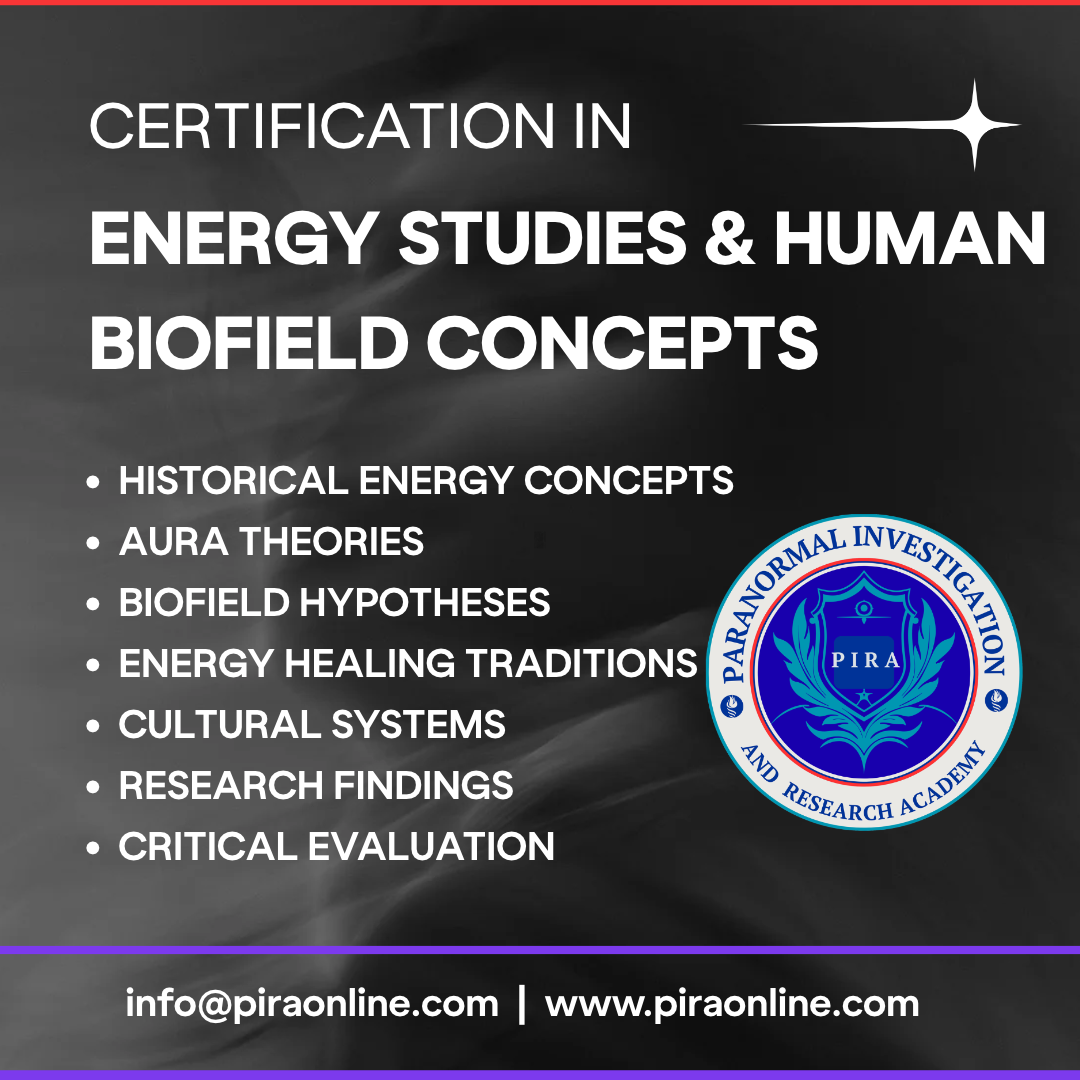
Energy Studies and Human Biofield Concepts
Complete Certification Course
Explore Traditional Energy Concepts, Aura Theories, Human Biofield Hypotheses, Energy Healing Practices, and the Science of Human Vitality
What do different cultures mean when they speak about life force, subtle energy, prana, qi, ki, or the human aura? How do traditional energy healing systems explain vitality and balance? What does modern science tell us about the measurable signals produced by the human body, and how can we investigate claims about subtle energy fields responsibly?
The Energy Studies and Human Biofield Concepts Certification Course offers a structured exploration of these fascinating questions.
This comprehensive educational program brings together historical traditions, cultural perspectives, contemporary biofield hypotheses, aura interpretations, energy healing practices, human perception, and scientific research. You will learn how different traditions understand vitality, how modern practitioners interpret energy-related experiences, and how researchers investigate claims about the human body and its surrounding environment.
Rather than asking you to accept every claim as fact, this course teaches you to examine ideas carefully, distinguish traditional explanations from scientific findings, evaluate evidence, and communicate your conclusions responsibly.
Whether you are interested in energy studies, holistic wellness education, traditional healing concepts, aura theories, biofield research, or the relationship between human experience and scientific investigation, this course provides a foundation for exploring the subject in a more informed and systematic way.
Explore the concepts. Understand the traditions. Investigate the claims. Learn to evaluate the evidence.
Discover the World of Energy Studies and Human Biofield Concepts
Throughout history, people have used different languages and frameworks to describe the qualities that make living things appear active, responsive, and alive.
Some traditions emphasize breath and vitality. Others describe patterns of balance, life force, subtle bodies, or relationships between people and their environment. Contemporary wellness practices may use terms such as aura, energy field, and biofield to explain experiences that practitioners interpret as energy-related.
However, these concepts do not all mean the same thing.
Traditional vitality concepts are not automatically equivalent to the scientific definition of energy. A reported sensation of warmth does not, by itself, demonstrate the presence of a subtle field. Likewise, the fact that the human body produces measurable electrical and magnetic signals does not establish every claim made about auras or energy healing.
This course explores these distinctions in detail.
You will examine the historical development of energy concepts, compare culturally specific traditions, study contemporary aura interpretations, explore proposed biofield models, and learn how scientific methods can be used to investigate claims.
The result is a broader understanding of the subject that combines cultural awareness, practical observation, research literacy, and critical thinking.
What Will You Learn?
By completing this certification course, you will develop knowledge and skills across several important areas.
1. Historical Foundations of Energy and Vitality
Explore how historical societies understood breath, warmth, movement, life, and the invisible forces they believed influenced living beings.
Study selected philosophical traditions, the historical development of vitalism, and the emergence of modern energy science. Learn why historical concepts should be interpreted within their original contexts rather than automatically translated into contemporary scientific terminology.
2. Traditional Energy Concepts Across Cultures
Examine prana in selected South Asian traditions, qi in Chinese philosophical and medical contexts, ki in Japanese traditions, and other culturally specific vitality frameworks.
Learn to compare these concepts without assuming that they are identical or that all traditions describe one scientifically established universal field.
3. Aura Theories and Human Energy-Field Interpretations
Explore the historical and contemporary interpretations of auras, including claimed layers, colors, patterns, and meanings.
Examine reports of aura perception, the influence of visual conditions and expectations, and the challenges involved in testing aura-reading claims.
Learn how to distinguish a reported experience from the interpretation attached to it.
4. Human Biofield Hypotheses and Proposed Mechanisms
Discover how the term human biofield is used in some contemporary complementary-health research and theoretical discussions.
Explore the difference between a broad conceptual framework, established biological processes, and specific claims about additional subtle fields. Learn why a scientific hypothesis needs clear definitions, measurable predictions, and methods that allow its claims to be tested.
5. Measurable Physical Signals of the Human Body
Understand that living bodies produce measurable physical signals through established physiological processes.
Explore concepts such as electrical activity associated with the heart and brain, body temperature, heat transfer, and other measurable biological phenomena.
Learn why these established signals must not automatically be treated as proof of an additional subtle energy field, and how measurement methods, instruments, and experimental conditions affect the conclusions researchers can draw.
6. Traditional Energy Healing Systems
Study the concepts and practices associated with selected traditional and contemporary energy healing approaches.
Explore how practitioners describe their methods, how sessions may be structured, and how cultural beliefs and personal experiences influence interpretations of the practice.
Learn to distinguish the description of a healing tradition from evidence supporting particular claims about its effects.
7. Human Perception and Subjective Energy Experiences
Investigate reports of warmth, tingling, pressure, pulsing sensations, perceived movement, emotional changes, and other experiences sometimes described as energy-related.
Explore how attention, expectations, sensory information, breathing, movement, relaxation, and environmental conditions may influence subjective experience.
Learn to document these experiences without automatically assuming either a paranormal explanation or a single ordinary cause.
8. Research Methods and Experimental Design
Develop an understanding of how claims can be examined through structured observation and controlled testing.
Learn about research questions, operational definitions, control conditions, blinding, randomization, comparison groups, consistent procedures, and clear outcome measures.
Discover how to reduce bias and design basic educational exercises that separate personal impressions from results that can be independently evaluated.
9. Evidence from Energy Healing and Biofield Research
Explore how research into biofield-related approaches and energy healing is conducted and evaluated.
Learn to assess study design, sample sizes, comparison conditions, outcome measures, possible sources of bias, statistical uncertainty, and the difference between a preliminary finding and a well-supported conclusion.
Develop the ability to read research summaries more critically rather than relying entirely on promotional claims or isolated positive results.
10. Critical Evaluation of Claims and Controversies
Examine common claims about aura detection, subtle energy transmission, energy balancing, and the proposed mechanisms of energy healing.
Learn to identify unsupported conclusions, vague terminology, inconsistent explanations, misleading comparisons, and interpretations that go beyond the available evidence.
Develop a consistent method for deciding what a source demonstrates, what it merely suggests, and what remains uncertain.
11. Ethical Practice, Applied Investigation, and Professional Communication
Bring together your learning through practical observation exercises, evidence reviews, and structured reports.
Learn to obtain consent, protect privacy, respect cultural traditions, communicate limitations, and avoid unsupported medical or psychological claims.
Develop a responsible framework for presenting energy-related concepts in educational, research, and non-clinical wellness settings.
Explore the Relationship Between Traditional Knowledge and Modern Science
One of the most valuable aspects of this course is its comparative approach.
You will explore traditional systems on their own terms while also learning how to assess claims that are presented as scientific.
For example, when studying prana, you will examine its traditional meanings and its role in selected practices. You will also learn why prana should not automatically be equated with oxygen or another single physiological measurement.
When studying qi, you will explore its use across different Chinese traditions without assuming that it is identical to electricity, magnetism, or a particular anatomical structure.
When examining aura theories, you will consider the experiences people report while learning how visual conditions, expectation, interpretation, and controlled testing affect the evaluation of those reports.
When studying the human biofield, you will distinguish established physiological signals from proposed additional fields and ask what evidence would be required to support a particular hypothesis.
This approach allows you to investigate an intriguing subject without confusing cultural meaning, personal experience, theoretical models, and established scientific findings.
A Closer Look at the Course Modules
Module 1 — Historical Foundations of Energy and Vitality Concepts
Discover how ideas about life force, breath, warmth, movement, and invisible influences developed across historical periods.
Explore early interpretations of vitality, the history of vitalism, selected ancient philosophical approaches, and the transition toward modern scientific definitions of energy.
You will also learn how to research historical sources and distinguish original concepts from later interpretations.
Practical outcome: Produce a historical foundations report comparing three vitality concepts and explaining their historical meanings and interpretive limitations.
Module 2 — Cultural Frameworks and Traditional Models of Life Force
Examine selected traditions involving prana, qi, ki, and other culturally specific concepts of vitality.
Explore the roles of breathing, movement, meditation, traditional health frameworks, community, and cultural context. Learn why concepts that appear similar in translation may have different meanings and purposes.
Practical outcome: Prepare a comparative study of four vitality concepts that identifies their contexts, similarities, differences, and limitations without treating them as interchangeable.
Module 3 — Aura Theories and Human Energy-Field Interpretations
Study the historical development of aura imagery, contemporary aura-reading systems, claimed colors and layers, and reported experiences of aura perception.
Explore visual perception, contextual influences, and the design of controlled tests for claims involving aura reading.
You will also learn to communicate aura interpretations responsibly without presenting subjective impressions as medical findings.
Practical outcome: Develop an aura-claim investigation plan and a sample report separating observation, interpretation, alternative explanations, and limitations.
Module 4 — Human Biofield Hypotheses and Proposed Mechanisms
Explore the human biofield concept as it appears in contemporary complementary-health research and theoretical discussions.
Learn to distinguish broad biofield frameworks from precisely defined hypotheses and established biological processes. Examine what makes a claim testable, how proposed mechanisms should be defined, and why measurable predictions are essential to scientific evaluation.
Practical outcome: Develop a structured explanation of a selected biofield hypothesis, identifying its terminology, proposed mechanism, testable predictions, and unresolved questions.
Module 5 — The Measurable Physical Signals of the Human Body
Explore the physical signals associated with normal biological processes and the instruments used to measure them.
Study electrical activity, magnetic signals, temperature, and other relevant physiological measurements. Learn about the conditions under which measurements are collected, what they can establish, and where their limitations begin.
Understand why evidence of ordinary biological activity should not be confused with proof of an additional subtle energy field.
Practical outcome: Prepare a measurement comparison report describing selected physiological signals, their measurement methods, and the limits of conclusions that can be drawn from them.
Module 6 — Traditional Energy Healing Systems and Session Frameworks
Examine selected traditional and contemporary energy healing approaches, including how practitioners describe their principles and organize their sessions.
Explore practitioner explanations, participant experiences, session procedures, and the distinction between a traditional account of a practice and evidence supporting specific outcomes.
Learn to approach these systems respectfully without assuming that their proposed mechanisms have been established.
Practical outcome: Create a descriptive session framework for a selected non-clinical practice, including consent, participant comfort, clear expectations, documentation, and appropriate boundaries.
Module 7 — Human Perception, Attention, and Subjective Energy Experiences
Investigate the experiences people may describe as sensing energy, feeling a field, noticing warmth, or detecting subtle movement.
Explore attention, expectation, sensory cues, relaxation, breathing, and environmental influences. Learn how to document subjective reports without automatically interpreting them as evidence of an external energy source.
Practical outcome: Design an observation exercise that records reported sensations, surrounding conditions, expectations, and uncertainty using a consistent procedure.
Module 8 — Research Methods and Experimental Design
Learn how to turn broad claims into questions that can be examined systematically.
Explore operational definitions, control conditions, blinding, randomization, consistent data collection, and the importance of reducing information leakage and experimenter influence.
Develop a framework for conducting basic, low-risk educational investigations and documenting their limitations.
Practical outcome: Prepare a research protocol for a selected biofield-related claim, including the research question, procedure, outcome measures, controls, and interpretation criteria.
Module 9 — Evidence from Energy Healing and Biofield Research
Learn how to examine published research involving biofield hypotheses and energy healing practices.
Explore study quality, comparison groups, sample sizes, outcome measures, bias, uncertainty, and the importance of replication. Understand why a positive result in one study does not automatically establish a general claim or its proposed mechanism.
Practical outcome: Produce a structured evidence review of a selected research claim, summarizing the available findings, limitations, and questions requiring further investigation.
Module 10 — Critical Evaluation of Claims, Controversies, and Limitations
Develop the skills needed to examine extraordinary claims without automatically accepting or rejecting them.
Explore unsupported mechanisms, vague definitions, selective reporting, confirmation bias, misleading comparisons, and conclusions that extend beyond the available data.
Learn to distinguish established findings, preliminary evidence, theoretical proposals, personal testimony, and unresolved questions.
Practical outcome: Evaluate a selected energy-related claim using an evidence checklist and prepare a balanced assessment of its strengths, weaknesses, and uncertainties.
Module 11 — Ethical Practice, Applied Investigation, and Professional Communication
Bring together historical understanding, cultural awareness, research literacy, and practical observation.
Learn how to communicate energy-related concepts accurately, obtain consent, protect participant information, respect cultural boundaries, and avoid unsupported promises or health-related claims.
Complete an applied project that demonstrates your ability to research a topic, examine evidence, document limitations, and communicate conclusions responsibly.
Practical outcome: Prepare a final case study or research report with a clear question, supporting sources, observations or findings, alternative interpretations, ethical considerations, and a conclusion proportionate to the evidence.
Learn Through Practical Activities and Applied Projects
This course is designed to encourage active learning rather than relying exclusively on theory.
Throughout your studies, you will have opportunities to apply the concepts through structured exercises such as:
- Comparing historical vitality concepts and their original meanings.
- Researching traditional energy frameworks using credible sources.
- Analyzing the different interpretations assigned to aura colors.
- Designing a neutral observation exercise involving visual perception.
- Drafting a blinded protocol for testing an aura-reading claim.
- Identifying the difference between established physiological signals and proposed subtle fields.
- Documenting subjective experiences without assuming their cause.
- Preparing a basic research protocol for a selected claim.
- Reviewing published studies and identifying methodological limitations.
- Evaluating a commercial or educational claim against available evidence.
- Preparing a cultural-context profile for a traditional practice.
- Writing an evidence-based report that communicates uncertainty clearly.
These activities help develop research literacy, observation, analytical thinking, and responsible communication.
They are educational exercises, not proof that a subtle energy field exists or that a particular healing method produces a specific outcome.
Who Is This Course For?
Holistic Wellness Students
People interested in exploring energy-related concepts and traditional wellness frameworks while developing a more careful understanding of evidence and limitations.
Energy Studies Enthusiasts
Learners fascinated by life-force concepts, aura theories, subtle-energy interpretations, and the relationship between human experience and the surrounding environment.
Traditional Healing and Cultural Studies Learners
Individuals who want to understand selected vitality traditions in their cultural and historical contexts without reducing them to a single universal theory.
Biofield Research Enthusiasts
People interested in how researchers formulate hypotheses, investigate biofield-related claims, and assess the quality of published findings.
Holistic Wellness Educators
Educators who want to explain traditional energy concepts and contemporary biofield hypotheses more accurately and responsibly.
Complementary Wellness Practitioners
Practitioners who wish to improve their research literacy, communication, ethical boundaries, and understanding of the distinction between traditional interpretations and established scientific evidence.
Curious Independent Learners
Anyone interested in examining a fascinating subject that brings together history, philosophy, human perception, traditional practices, and scientific inquiry.
No advanced scientific background is assumed. An open mind, a willingness to examine different perspectives, and an interest in careful reasoning will help you get the most from the course.
What Makes This Course Different?
It Examines Claims Rather Than Simply Repeating Them
You will not be asked to accept every energy-related explanation as established fact. You will learn how to identify the claim being made, examine its supporting evidence, and recognize what remains uncertain.
It Respects Traditional Knowledge and Cultural Differences
The course explores selected traditions within their historical and cultural settings. It avoids assuming that prana, qi, ki, aura concepts, and contemporary biofield hypotheses are different names for one identical phenomenon.
It Connects Subjective Experience With Research Literacy
Personal experiences can be meaningful to the people who report them. However, the experience itself and the explanation for it are separate questions. You will learn to document both carefully and avoid drawing conclusions that the evidence cannot support.
It Explains the Difference Between Physical Energy and Subtle-Energy Claims
Modern science uses specific definitions and measurement methods for energy and biological signals. The course helps you distinguish these established concepts from proposed subtle fields that require their own clear definitions and evidence.
It Emphasizes Practical Observation and Clear Documentation
Through research exercises, observation protocols, comparative studies, and evidence reviews, you will develop a more organized approach to investigating energy-related claims.
It Encourages Responsible Communication
You will learn to discuss traditional practices, aura interpretations, and biofield hypotheses without making unsupported promises, diagnosing health conditions, or presenting speculative mechanisms as established science.
What Skills Can You Develop?
By the end of the course, you should be better prepared to:
- Explain the historical development of selected vitality concepts.
- Compare traditional energy frameworks while respecting cultural differences.
- Describe contemporary aura theories and biofield hypotheses accurately.
- Distinguish established physiological signals from proposed subtle fields.
- Recognize the limitations of subjective reports and personal testimony.
- Develop basic protocols for observing and investigating claims.
- Identify common sources of bias in research and interpretation.
- Read research summaries and assess study limitations.
- Prepare structured evidence reviews and research reports.
- Communicate uncertainty and competing interpretations clearly.
- Apply ethical principles when discussing energy-related practices.
- Develop an independent learning or research project in a selected area of energy studies.
These skills can support further study, educational projects, research-oriented content, and responsible non-clinical wellness education.
Explore Possible Directions After Completing the Course
The knowledge developed through this course may support a variety of educational and independent projects, depending on your interests and further experience.
You may choose to explore:
Energy Studies Education: Develop educational material explaining historical vitality concepts, traditional frameworks, aura theories, and biofield hypotheses.
Holistic Wellness Education: Create general educational resources about traditional practices, participant experiences, research literacy, and responsible communication.
Research and Evidence Reviews: Prepare literature summaries, comparative studies, or independent research projects examining selected energy-related claims.
Cultural and Historical Research: Investigate the development of traditional vitality concepts and their interpretation in contemporary wellness culture.
Educational Content Creation: Develop articles, presentations, videos, or learning materials that help audiences distinguish traditional explanations, personal experiences, and scientific findings.
Independent Study Projects: Build a portfolio of comparative research, structured observations, and evidence evaluations in an area that interests you.
These are possible educational directions, not guaranteed career outcomes. This course does not establish clinical competence, authorize medical treatment, or guarantee employment, income, clients, or professional recognition.
Frequently Asked Questions
1. What is the Energy Studies and Human Biofield Concepts Certification Course?
It is an educational program exploring historical energy concepts, traditional vitality systems, aura theories, human biofield hypotheses, energy healing practices, human perception, scientific research, and evidence evaluation.
2. Is this course about auras and subtle energy fields?
Yes. It examines aura theories and proposed subtle fields, including how these ideas developed, how they are interpreted, and how related claims may be investigated. It does not assume that all such fields have been scientifically established.
3. Will I learn about prana, qi, and ki?
Yes. The course explores selected cultural and philosophical contexts for these concepts and explains why they should not automatically be treated as interchangeable or equivalent to specific physical measurements.
4. Does the course teach energy healing?
The course examines traditional and contemporary energy healing approaches, their explanatory frameworks, and the ways practitioners may organize sessions. It also considers research evidence, ethical boundaries, and limitations. It should not be treated as clinical training or proof that a particular method has a specific therapeutic effect.
5. Will I learn about scientific research?
Yes. You will study research questions, measurement, controlled testing, bias, evidence evaluation, study limitations, and the responsible interpretation of findings.
6. Does modern science prove that the human aura exists?
The course does not present the aura as an established scientific field. It examines aura interpretations and reports of aura perception, including the challenges involved in testing claims and distinguishing subjective experiences from independently measurable phenomena.
7. Is the human biofield a scientifically established concept?
The term is used in some contemporary complementary-health research and theoretical discussions, but its meaning and proposed mechanisms vary. Specific claims must be evaluated individually. Evidence for ordinary physiological signals does not automatically establish an additional subtle field.
8. Do I need a scientific background?
No advanced scientific background is assumed. The course introduces the relevant concepts and develops your ability to understand research claims and evaluate evidence step by step.
9. Are there practical assignments?
Yes. The course includes historical research, cultural comparisons, observation exercises, research protocol development, evidence reviews, and a final applied project.
10. Can this certification help me work in holistic wellness education?
The course may help you develop subject knowledge and responsible communication skills for educational projects. Any professional activity must remain within your actual competence and comply with applicable local laws and requirements.
11. Does this certification qualify me to diagnose or treat medical conditions?
No. The course is educational and does not qualify you to diagnose, prevent, or treat medical conditions. Aura interpretations and energy-related experiences should not be used as substitutes for appropriate medical or mental health assessment.
12. Is this a government-issued or regulated professional qualification?
The certificate represents completion of the training offered by the course provider. Unless specifically stated and independently verified, it should not be represented as a government-issued qualification, a regulated professional license, or a guarantee of professional recognition.
13. What will I complete during the course?
Your learning activities may include historical and cultural studies, auras and biofield claim evaluations, observation protocols, research reviews, and a final written project. These activities are designed to demonstrate your understanding of the course material and your ability to communicate findings responsibly.
Begin Your Journey into Energy Studies
Energy concepts occupy an intriguing space where history, philosophy, cultural traditions, personal experience, complementary wellness, and scientific inquiry meet.
Understanding this subject requires more than memorizing definitions or accepting popular explanations. It requires the ability to examine different perspectives, recognize the limits of existing knowledge, ask meaningful questions, and evaluate claims carefully.
The Energy Studies and Human Biofield Concepts Certification Course gives you a structured opportunity to explore these topics while developing the skills to research, analyze, and communicate them responsibly.
Discover how traditional vitality concepts developed, explore contemporary aura and biofield theories, examine the measurable signals of the human body, and learn how researchers evaluate claims involving energy-related experiences.
Enroll today and begin developing your knowledge of energy studies, human biofield concepts, and the responsible investigation of extraordinary claims.
Educational disclaimer: This course examines traditional beliefs, subjective experiences, hypotheses, and research findings. It does not assume that auras or additional subtle energy fields have been scientifically established, and it does not replace medical or mental health education, assessment, or treatment.
Reviews
There are no reviews yet.