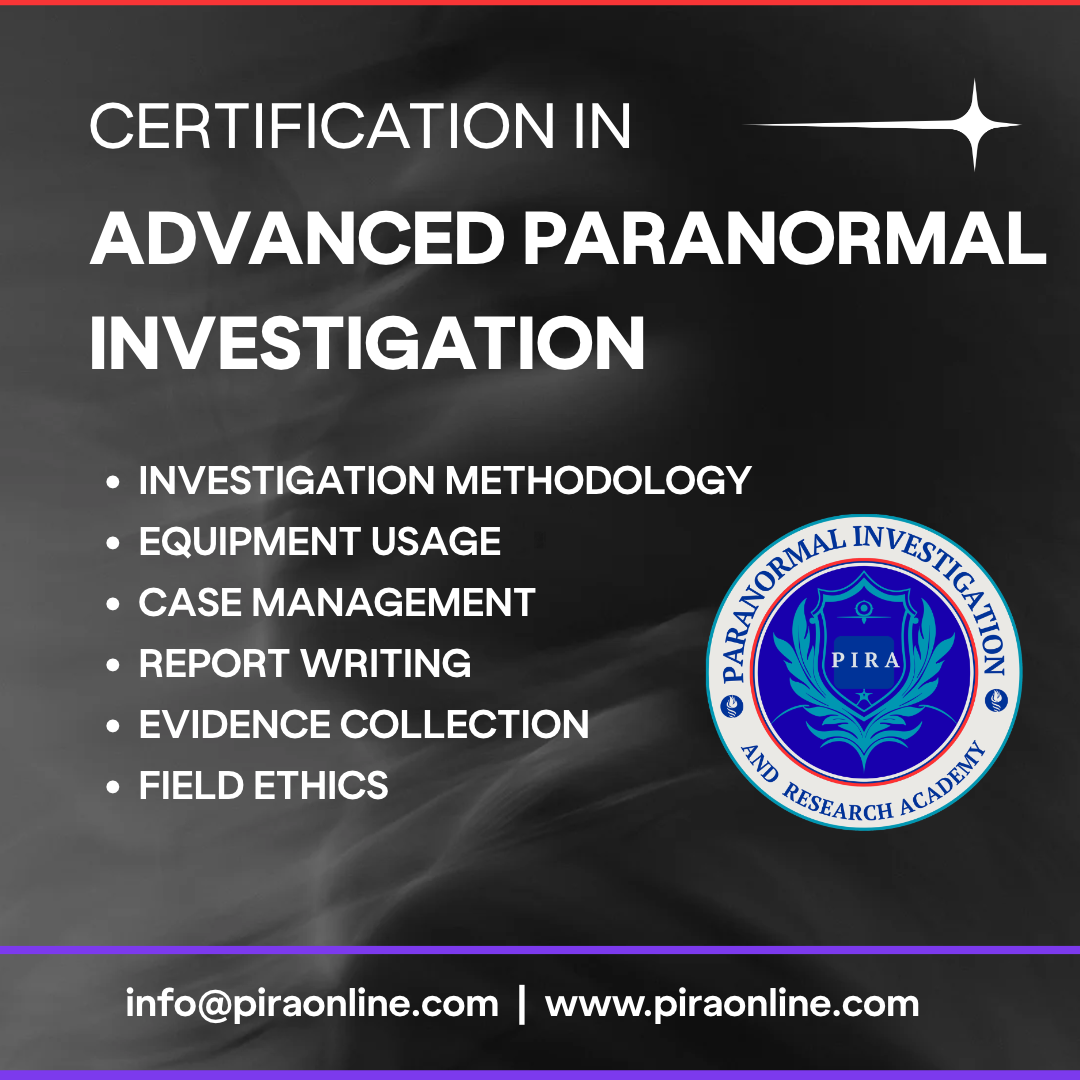
Certification in Advanced Paranormal Investigation
Original price was: ₨12,000.00.₨7,500.00Current price is: ₨7,500.00.
Become Internationally Recognized Paranormal Investigator Advanced Certification
Complete Professional Training Course

Turn Your Interest in the Paranormal into Practical Investigative Skills
Have you ever wanted to investigate reportedly haunted locations, examine unexplained experiences, analyze unusual recordings, or learn how professional paranormal investigations are conducted?
The How to Become a Paranormal Investigator Advanced Certification course is designed to help you move beyond casual ghost hunting and develop the practical knowledge, investigative methods, and professional habits needed to conduct structured paranormal investigations.
This comprehensive training program takes you through the investigative process step by step. You will learn how to research reportedly haunted locations, interview witnesses, assess cases, choose investigation equipment, manage field risks, document unusual events, evaluate alternative explanations, preserve evidence, and communicate your findings responsibly.
Whether your interest lies in haunted houses, unexplained sounds, electronic voice phenomena, poltergeist reports, photographic anomalies, historical hauntings, or independent paranormal research, this course gives you a structured foundation for developing your skills.
Learn the methods. Practice the process. Build your investigative portfolio.
What is Include:
- Completely Online
- 21 Video Lectures (More Than 30 Hours of Videos)
- 21 Module with Detailed Notes
- Frequently Asked Questions
- Assignments
- Test Your Knowledge Questions
- Certification Exams
- 60+ Guides, Templates & Resources
- Digital Certificate
- Free Listing in Paranormal Investigator Directory
Why Choose This Paranormal Investigator Certification Course?
Watching paranormal investigation videos and visiting reportedly haunted locations can be exciting, but conducting a structured investigation requires much more than a camera, a flashlight, and a willingness to explore.
A skilled investigator must know how to collect reliable information, ask neutral questions, identify possible environmental explanations, preserve original recordings, protect witnesses, and distinguish what was actually observed from what someone believes may have caused it.
This course focuses on those practical responsibilities.
Instead of encouraging you to accept every unusual event as paranormal, you will learn how to examine claims systematically, compare possible explanations, and reach conclusions that reflect the available information.
You will also learn how to approach investigations professionally, protect the privacy of participants, obtain permission before entering properties, plan for physical safety, and develop a consistent method for handling cases.
The goal is to help you develop a more disciplined, organized, and responsible approach to paranormal investigation.
What Will You Learn?
By completing this 21-module professional training program, you will develop knowledge and practical skills in the following areas.
1. Understanding the Paranormal Investigation Profession
Discover what paranormal investigators actually do and how their work differs from entertainment-focused ghost hunting and general paranormal research.
Explore the main areas of investigation, identify your personal interests, assess your current abilities, and develop a structured plan for improving your skills.
2. Critical Thinking and Evidence Evaluation
Learn how to separate observations from interpretations and recognize the influence of expectations, confirmation bias, environmental conditions, and human perception.
Develop a consistent process for examining unusual reports, generating competing explanations, and identifying what additional information is needed before reaching a conclusion.
3. Choosing Your Paranormal Investigation Specialty
Explore different investigative fields, including reportedly haunted locations, apparitions, electronic voice phenomena, alleged poltergeist activity, photographic anomalies, unusual sounds, and historical haunting reports.
Compare the requirements of different specialties and select a primary field of interest along with a supporting specialty for your professional development.
4. Researching Haunted Locations and Cases
Learn how to investigate the background of a location before visiting it.
Explore historical records, newspaper archives, local history resources, witness accounts, photographs, and published reports. Discover how to trace the origins of haunting stories, compare conflicting accounts, map reported activity, and prepare an organized research dossier.
5. Case Intake and Witness Interviews
Learn how to receive investigation requests and gather useful information before conducting fieldwork.
Practice asking open-ended questions, documenting witness accounts, establishing event timelines, identifying missing information, and assessing whether a case is suitable for investigation.
You will also learn how to prepare a case brief with clear investigative objectives.
6. Professional Ethics, Permissions, and Privacy
Understand the responsibilities involved in investigating private properties and working with people who report unexplained experiences.
Learn about obtaining authorization, explaining investigative procedures, securing consent for recordings, protecting confidential information, respecting cultural and religious practices, and maintaining professional boundaries.
Develop your own investigator code of conduct and learn why fabricated evidence, misleading editing, unauthorized access, and exaggerated claims undermine investigative credibility.
7. Physical Safety and Field Risk Management
Prepare for field investigations by learning how to identify potential hazards, plan emergency procedures, assess site conditions, and establish team safety protocols.
Explore the risks associated with unstable buildings, electrical hazards, poor air quality, environmental exposure, fatigue, and unfamiliar locations.
Learn when to postpone or cancel an investigation and when a concern should be referred to an appropriate safety professional.
8. Building Your Paranormal Investigation Equipment Kit
Discover how to choose equipment according to your investigative objectives rather than relying on expensive devices or unsupported marketing claims.
Learn about essential beginner tools, recording equipment, observation materials, lighting, batteries, and practical field supplies. Understand the purpose and limitations of different tools and why equipment readings must be interpreted carefully.
9. Planning and Preparing Field Investigations
Learn how to turn background research and witness information into a structured fieldwork plan.
Develop clear investigative questions, organize equipment, establish team responsibilities, identify observation areas, prepare recording procedures, and document the conditions that may affect the investigation.
10. Conducting Structured Fieldwork
Develop a systematic approach to observing and documenting reported activity at an authorized location.
Learn how to maintain accurate field notes, record timestamps, document environmental conditions, follow a planned observation sequence, and avoid allowing expectations to influence what you record.
11. Investigating Unusual Sounds and Electronic Voice Phenomena
Explore how investigators examine reported electronic voice phenomena and other unexplained audio recordings.
Learn about recording conditions, background noise, equipment limitations, audio review, ambiguous sounds, and the importance of preserving original files.
Develop a repeatable method for reviewing recordings without automatically interpreting unclear sounds as words or attributing them to a paranormal source.
12. Examining Apparitions and Visual Anomalies
Learn how to document reports of figures, shadows, unusual lights, reflections, and unexpected visual appearances.
Explore the importance of lighting, viewing distance, movement, camera settings, environmental conditions, and witness descriptions.
Understand how to compare visual reports with other information and why unusual appearances in photographs or videos do not automatically establish a paranormal explanation.
13. Examining Poltergeist Reports and Physical Disturbances
Discover how to document reports involving knocks, object movement, recurring disturbances, and unexplained changes within a location.
Learn to record event timing, object positions, witness accounts, and relevant environmental conditions while considering physical, mechanical, human, and other possible explanations.
Focus on safe observation and careful documentation rather than dangerous attempts to provoke activity.
14. Environmental Factors and Alternative Explanations
Learn why environmental conditions must be considered when investigating unusual experiences.
Explore how sounds, reflections, shadows, building conditions, electronic interference, recording artefacts, and other ordinary factors may contribute to reported events.
Develop a consistent method for checking explanations where practical, identifying limitations, and documenting unresolved questions.
15. Recording, Organizing, and Reviewing Evidence
Develop an organized approach to handling photographs, audio files, video recordings, written observations, environmental readings, and witness statements.
Learn why original records matter, how to maintain clear file organization, and how to document the steps taken during evidence review.
Understand the difference between an unusual recording, an observation that remains unexplained, and evidence that supports a particular conclusion.
16. Evidence Preservation and Case Documentation
Learn how to maintain accurate case records from the initial report through the final review.
Explore file naming, timestamps, original media preservation, access records, documentation of changes, and transparent evidence handling.
Develop practices that help other people understand where information came from, how it was collected, and whether it can be independently reviewed.
17. Analyzing Evidence and Evaluating Findings
Learn how to compare witness accounts, historical information, recordings, field notes, and environmental observations.
Practice identifying inconsistencies, distinguishing direct observations from interpretations, evaluating alternative explanations, and acknowledging the limits of available information.
Develop a balanced approach to findings that may be explained, partially explained, unresolved, or limited by insufficient information.
18. Writing Professional Paranormal Investigation Reports
Discover how to transform investigation notes and collected records into a clear, organized report.
Learn how to summarize the original claim, explain the methods used, document observations, present relevant records, discuss alternative explanations, and communicate uncertainty.
Develop a reporting style that avoids sensational language and makes it easier for readers to evaluate the investigation for themselves.
19. Communicating Findings and Working With Clients
Learn how to explain investigation results to witnesses, property owners, team members, and interested audiences.
Explore responsible communication, confidentiality, limitations, informed expectations, and the importance of avoiding unsupported claims that could frighten or mislead people.
Understand how to discuss unresolved experiences without presenting speculation as established fact.
20. Building Your Paranormal Investigation Portfolio
Learn how to document your development through case studies, research dossiers, field notes, investigation reports, equipment procedures, and practical assignments.
Explore ways to present your work professionally while respecting privacy, property permissions, and evidence limitations.
Develop a portfolio that demonstrates your investigative process rather than relying only on dramatic photographs or unexplained recordings.
21. Developing Your Paranormal Investigation Practice
Bring your learning together into a practical development plan.
Explore how to organize future investigations, establish standard procedures, develop a specialty, build a responsible research network, and identify possible directions in independent investigation, educational content, historical research, and media-related work.
Create a plan for continuing your education, improving your methods, documenting experience, and developing your own investigative identity.
The detailed lesson coverage and practical activities are designed to support a structured learning journey from introductory knowledge to advanced investigative practice.
A Practical Course, Not Just Paranormal Theory
This course is designed around the real tasks involved in investigating reports of unexplained experiences.
Throughout the program, you will be encouraged to apply what you learn through structured activities and practical exercises.
Your learning activities may include:
- Creating a personal paranormal investigator development plan.
- Evaluating hypothetical reports using critical thinking.
- Selecting a primary investigation specialty.
- Researching the history of a reportedly haunted location.
- Preparing a historical research dossier.
- Completing a case intake form and witness interview.
- Drafting a professional code of conduct.
- Preparing a property permission checklist.
- Developing a site-specific risk assessment.
- Planning an emergency response procedure.
- Creating an equipment selection plan.
- Organizing investigation notes and digital records.
- Evaluating alternative explanations for unusual reports.
- Preparing structured case documentation and investigation reports.
- Developing a professional investigation portfolio.
These activities are intended to help you move beyond simply learning terminology and begin applying investigative principles to realistic situations.
Who Is This Course For?
The How to Become a Paranormal Investigator Advanced Certification course may be suitable for:
Aspiring Paranormal Investigators
People who want a structured starting point for learning how to investigate reportedly haunted locations and unexplained experiences.
Ghost Hunting Enthusiasts
Individuals who already enjoy paranormal investigations and want to improve their planning, documentation, safety procedures, and evidence-review methods.
Paranormal Researchers
People interested in studying haunting reports, historical cases, unusual sounds, witness experiences, and unexplained events in a more organized way.
Paranormal Content Creators
Video creators, bloggers, podcasters, and documentary enthusiasts who want to improve their research, recording practices, and responsible presentation of paranormal claims.
Historical Haunting Researchers
Individuals interested in tracing the origins of haunting stories, examining historical records, comparing accounts, and documenting reportedly haunted locations.
Independent Investigators
People who want to develop their own investigation procedures, research specialty, portfolio, or independent project.
Curious Learners
Anyone interested in the methods, equipment, reasoning skills, and ethical responsibilities involved in paranormal investigation.
No previous professional paranormal investigation experience is required to begin learning. A willingness to observe carefully, question assumptions, follow safety procedures, and document findings honestly will be valuable throughout the course.
What Makes a Responsible Paranormal Investigator Different?
A responsible investigator does not need to promise that every case will reveal something extraordinary.
Instead, the investigator develops a repeatable process for collecting information and examining what happened.
Consider the difference between these two approaches.
An assumption-based approach: A strange noise occurs in an old building, so the investigator immediately declares that a spirit is present.
A structured investigative approach: The investigator records the noise, documents the time and location, interviews witnesses, checks relevant environmental and mechanical possibilities, reviews available recordings, and explains what the information does and does not establish.
The second approach produces a more transparent investigation, regardless of whether the event is explained.
Throughout this course, you will learn to prioritize careful observation, accurate documentation, appropriate safety precautions, and honest communication.
You will also learn that an unresolved event is not automatically proof of a paranormal cause. An investigation can still be valuable when it identifies a likely explanation, eliminates some possibilities, or documents the limits of the available evidence.
Develop Skills That Can Support Your Future Projects
Paranormal investigation can connect with several interests, including historical research, audio and video analysis, documentary production, educational content, case documentation, and independent investigation projects.
As you develop your skills, you may choose to:
- Conduct authorized investigations of reported haunting cases.
- Research the history and origins of local haunting stories.
- Develop a paranormal research blog or educational channel.
- Create documentaries or informational videos about investigated cases.
- Build a collection of carefully documented case studies.
- Collaborate with other researchers on suitable projects.
- Develop educational materials about paranormal investigation methods.
- Establish an independent investigation project with clear procedures and ethical standards.
These are possible directions rather than guaranteed career outcomes. Opportunities depend on your experience, resources, location, reputation, relevant permissions, and the requirements of the work you pursue.
The course is intended to help you build a stronger practical foundation for exploring these possibilities responsibly.
Your Learning Journey: From Beginner to Structured Investigator
The course follows a progressive learning path.
First, understand the profession. Explore investigative responsibilities, develop critical thinking, choose your specialty, and learn to research cases.
Next, prepare for fieldwork. Practice witness interviews, establish ethical procedures, assess safety risks, and select appropriate equipment.
Then, develop your investigative methods. Learn to document reported events, examine recordings, consider alternative explanations, organize evidence, and preserve original records.
Finally, bring your work together. Evaluate findings, prepare professional reports, communicate responsibly, build a portfolio, and plan your continued development.
By following this learning journey, you can begin developing a consistent approach to paranormal investigation rather than relying on guesswork or unstructured exploration.
Frequently Asked Questions
1. What is the How to Become a Paranormal Investigator Advanced Certification course?
It is a professional training course designed to teach the foundational and advanced practical principles involved in researching, planning, conducting, documenting, and reviewing paranormal investigations.
2. Do I need previous paranormal investigation experience?
No previous professional experience is required to begin. The course introduces key concepts before progressing into practical investigative procedures and case documentation.
3. Will I learn how to investigate haunted houses?
Yes. The curriculum addresses reportedly haunted locations, historical research, witness interviews, investigation planning, field observations, environmental considerations, and case reporting.
4. Will I learn about ghost hunting equipment?
Yes. The course includes equipment selection and the importance of understanding what different tools can record, what their limitations are, and how their results should be interpreted.
5. Will I learn about electronic voice phenomena?
The course covers reported electronic voice phenomena and unexplained audio, including recording conditions, background noise, audio review, and the importance of preserving original files.
6. Does the course teach how to evaluate paranormal evidence?
Yes. You will study observation, alternative explanations, evidence documentation, recording review, uncertainty, and responsible interpretation of findings.
7. Will I receive practical assignments?
The curriculum includes practical exercises involving case analysis, historical research, witness interviews, safety planning, equipment selection, and professional documentation.
8. Can this course help me start my own paranormal investigation project?
It can help you develop investigative procedures, identify a specialty, organize case records, and build a portfolio. Any independent activity should comply with applicable laws, property permissions, privacy requirements, and safety standards.
9. Does completing this course guarantee that I will become a professional paranormal investigator?
No. Completing a training course can support your learning and development, but professional competence also depends on practice, experience, judgment, and compliance with relevant requirements. The course does not guarantee employment, clients, income, or investigative success.
10. Does this certification prove that paranormal phenomena exist?
No. The course teaches methods for examining reported experiences and evaluating available information. Its purpose is to help students investigate responsibly, not to assume that every unusual event has a paranormal cause.
11. Is this a government-issued qualification or license?
The course certificate represents completion of the training offered by the course provider. Unless explicitly stated and independently verified, it should not be represented as a government-issued qualification, a regulated professional license, or a guarantee of professional recognition.
12. What can I do after completing the course?
You can use your learning to continue practicing investigative methods, develop a case-study portfolio, conduct appropriately authorized research, create educational material, or explore independent projects that match your interests and experience.
Begin Your Journey into Paranormal Investigation
If you are fascinated by reportedly haunted locations, unexplained experiences, unusual recordings, and the challenge of investigating claims carefully, this course offers a structured path for developing your knowledge and practical skills.
Learn how to research cases, interview witnesses, plan fieldwork, select equipment, document observations, review evidence, evaluate alternative explanations, and present findings responsibly.
Build a stronger understanding of the investigative process and begin developing your own approach to paranormal research.
Enroll in the How to Become a Paranormal Investigator Advanced Certification course today and take the next step toward becoming a more organized, skilled, and responsible paranormal investigator.
Course note: This training is educational in nature. Paranormal claims should be evaluated critically, and course completion does not establish the existence of paranormal phenomena or confer any government license or regulated professional status.
Reviews
There are no reviews yet.