Description
Certificate in Survival and Afterlife Research
Investigate Near-Death Experiences, Mediumship, Reincarnation Reports, Apparitions, and the Evidence for Survival of Consciousness
What happens to consciousness when the body dies? Can unusual experiences surrounding death provide evidence of survival? How can researchers investigate extraordinary claims without allowing personal beliefs to determine the conclusions?
For centuries, people across cultures have explored the possibility that consciousness, identity, or some aspect of a person may continue after physical death. Reports of near-death experiences, encounters with deceased relatives, children’s alleged past-life memories, mediumship, apparitions, and unusual end-of-life experiences continue to raise fascinating questions.
The Certificate in Survival and Afterlife Research offers a structured educational journey into these subjects, combining case investigation, interviewing, evidence evaluation, psychological analysis, research ethics, and practical research methods.
This is not a course that asks you to believe in an afterlife—or to dismiss the possibility before examining the evidence. Instead, you will learn how to investigate reported experiences, preserve original information, compare competing explanations, evaluate the reliability of witnesses, and produce balanced research reports.
You will explore the methods used to study extraordinary claims, learn why some reports are more informative than others, and discover how to distinguish personal testimony from corroborated evidence and controlled experimental findings.
Explore one of humanity’s most enduring questions through systematic investigation, critical thinking, and responsible research.
What Is the Certificate in Survival and Afterlife Research?
Survival and afterlife research examines reports and evidence relating to the possibility that consciousness, personal identity, memory, or some other aspect of a person may continue after bodily death.
The field includes several areas of investigation, such as:
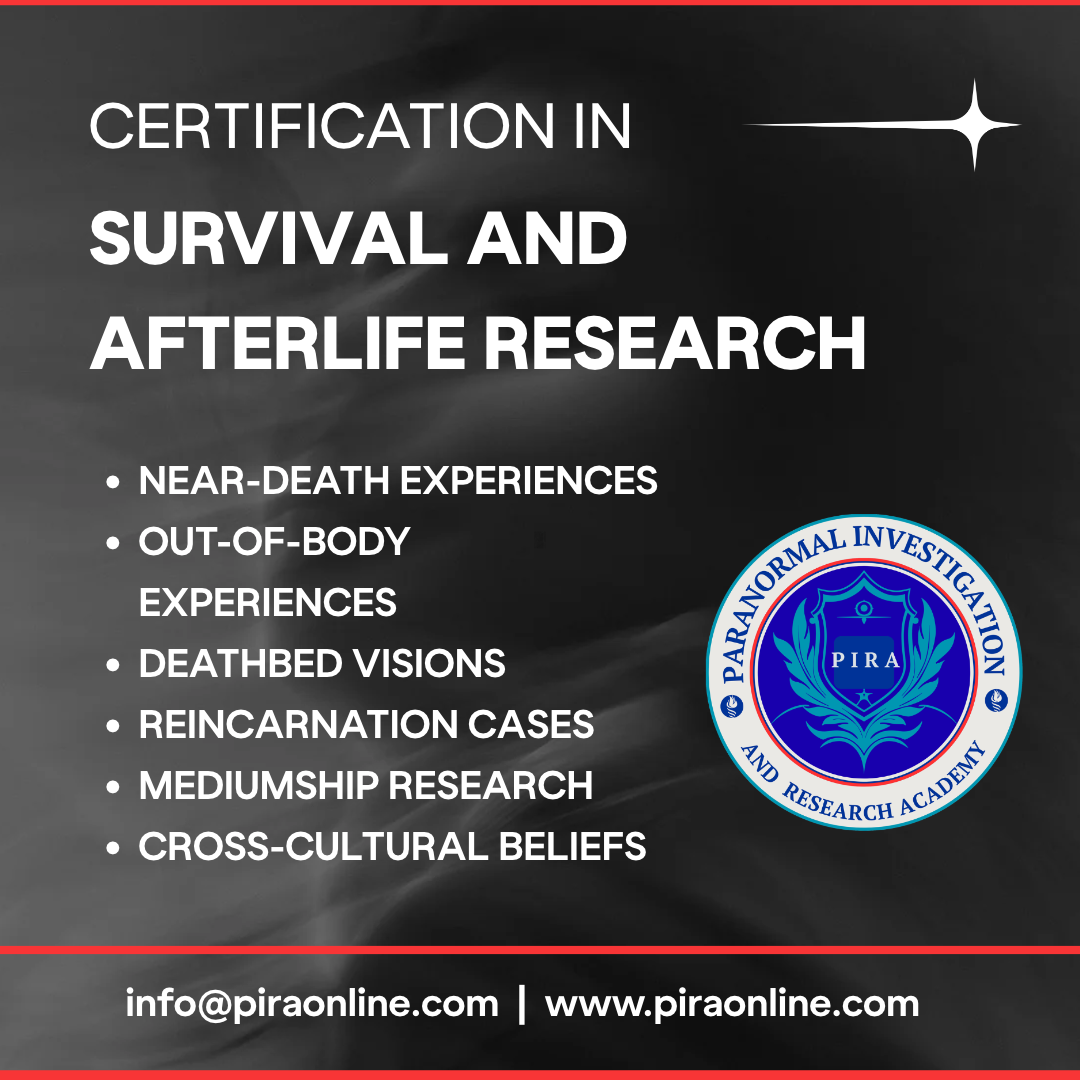
- Near-death experiences and reported perceptions during life-threatening circumstances.
- Out-of-body experiences and claims of perception from a location outside the physical body.
- Deathbed visions and experiences reported near the end of life.
- Children who report memories interpreted as belonging to a previous life.
- Mediumship and claims of communication with deceased individuals.
- Apparitions and experiences involving the apparent presence of deceased people.
- Terminal lucidity and unexpected changes in mental clarity near death.
- Shared death-related experiences reported by relatives, caregivers, or other witnesses.
- Cross-cultural beliefs and interpretations concerning death and survival.
These subjects do not all involve the same research questions, and evidence relevant to one phenomenon does not automatically establish an explanation for another.
Some reports may be investigated through interviews and documentary records. Others may require experimental controls, statistical analysis, independent witnesses, or comparison with psychological, neurological, environmental, and cultural explanations.
This course teaches you to approach each case according to the evidence available, rather than treating every unusual experience as proof of survival or dismissing every report without investigation.
The central question is simple to state but difficult to answer: What does the evidence support, what remains uncertain, and what further investigation would help distinguish competing explanations?
Why Choose This Course?
Learn practical case investigation
Discover how to turn an initial report into an organized research case. You will learn to establish timelines, conduct interviews, identify witnesses, collect relevant documentation, and separate original statements from later interpretations.
Explore major survival-related phenomena
Study near-death experiences, out-of-body experiences, deathbed visions, reincarnation-type cases, mediumship, apparitions, terminal lucidity, and related death experiences.
Develop professional interviewing skills
Learn how to ask neutral questions, preserve a person’s original account, avoid leading language, compare independent witness statements, and recognize when memories may have changed over time.
Understand evidence and alternative explanations
Explore how psychological, neurological, environmental, cultural, and ordinary information sources can help explain reported experiences. Learn to assess which explanations remain plausible after investigation.
Study research methods
Develop an introductory understanding of qualitative research, quantitative research, comparative case studies, surveys, experimental controls, randomization, blinding, statistical interpretation, and research protocols.
Build a structured research portfolio
Create case files, evidence matrices, interview records, comparative datasets, research proposals, and final reports that demonstrate your understanding of responsible investigation.
Approach sensitive subjects ethically
Learn how to work respectfully with bereaved families, people reporting unusual experiences, children, and other potentially vulnerable participants. Protecting participants and avoiding unsupported promises are essential parts of responsible research.
What Will You Learn?
By completing the course, you will develop an educational foundation in:
- Understanding the survival hypothesis and the relationship between consciousness and the brain.
- Distinguishing spiritual beliefs, personal experiences, scientific hypotheses, testimony, and research evidence.
- Formulating testable questions about survival-related claims.
- Investigating and documenting near-death experiences.
- Examining out-of-body experiences and claims of veridical perception.
- Interviewing experiencers, family members, healthcare professionals, and independent witnesses.
- Evaluating deathbed visions and other reported end-of-life experiences.
- Investigating children’s statements interpreted as memories of previous lives.
- Examining mediumship claims and possible sources of information leakage.
- Documenting apparitions, crisis experiences, and unusual encounters.
- Studying reports of terminal lucidity and shared death-related experiences.
- Comparing interpretations of death and survival across different cultures.
- Using qualitative and quantitative research methods.
- Evaluating witness reliability, documentary evidence, and the quality of corroboration.
- Recognizing confirmation bias, memory reconstruction, suggestion, fraud, and selective reporting.
- Creating professional case files and preserving original records.
- Applying informed consent, confidentiality, and ethical research procedures.
- Writing balanced case reports that include evidence strengths, weaknesses, and alternative explanations.
- Designing independent research projects and presenting conclusions responsibly.
Complete Course Curriculum
The fifteen-module program moves from foundational concepts to detailed case investigation, research methods, evidence evaluation, ethical practice, and independent research.
Introduction — Entering the Study of Survival and Afterlife
Begin by exploring why people investigate death, consciousness, and the possibility of survival beyond bodily death.
You will learn the difference between spiritual belief, religious doctrine, personal experience, anecdotal testimony, scientific hypotheses, and research evidence.
The introduction surveys the major topics covered throughout the course, including near-death experiences, out-of-body experiences, deathbed visions, reincarnation-type cases, mediumship, apparitions, terminal experiences, and cross-cultural survival beliefs.
You will also explore confirmation bias, belief-driven investigation, neutral documentation, and the importance of recognizing when a case requires medical, psychological, legal, or emergency intervention rather than paranormal investigation.
The goal is to establish a research mindset that welcomes questions without assuming that an extraordinary interpretation is automatically correct.
Practical activity: Write a Researcher Position Statement explaining your current beliefs, areas of uncertainty, what evidence could change your opinion, and how you will prevent personal beliefs from controlling your investigations.
Module 1 — The Survival Question and Research Framework
Explore the central question of survival research: Can consciousness, personal identity, or some aspect of experience continue independently of the biological body?
You will examine the difference between survival, immortality, reincarnation, and communication with the deceased. The module introduces competing philosophical and explanatory positions, including brain-generated consciousness, brain-mediated models, consciousness as a fundamental phenomenon, reincarnation hypotheses, and spiritual or religious interpretations.
You will learn to distinguish different forms of evidence, including direct observation, testimony, independent corroboration, documentary records, physical evidence, experimental results, statistical findings, and replicated research.
The module also introduces a practical framework for organizing an investigation around a research question, the phenomenon being studied, evidence requirements, alternative explanations, data collection, and evaluation criteria.
Practical assignment: Create a research protocol for investigating a survival-related claim, including a question tree, evidence requirements, alternative explanations, and standards for drawing conclusions.
Module 2 — Near-Death Experiences: Researching the Threshold of Death
Investigate near-death experiences, commonly known as NDEs, and the wide range of experiences reported by people who have survived life-threatening circumstances.
You will explore reports of separation from the body, altered perception, tunnel experiences, light, encounters with beings or deceased relatives, life reviews, time distortion, feelings of peace, distressing experiences, and claims of obtaining information.
The module focuses on how these experiences can be documented without imposing an interpretation on the person describing them.
You will learn to conduct open-ended interviews, reconstruct timelines, record exact statements, identify uncertain memories, and distinguish what a person originally reported from explanations developed afterward.
Particular attention is given to veridical NDE claims, in which a person reports apparently accurate information that they believe was obtained during the experience. You will learn to investigate when the information was perceived, who knew it, when it was recorded, and whether ordinary sources could explain how it was obtained.
You will also compare possible neurological, physiological, psychological, memory-related, and cultural explanations with non-local consciousness hypotheses.
Practical assignment: Prepare a complete NDE case file containing the original narrative, medical circumstances where legitimately available, timeline, witness testimony, documentary evidence, corroboration, alternative explanations, strengths, weaknesses, and a balanced conclusion.
Module 3 — Out-of-Body Experiences and the Question of Disembodied Perception
Explore out-of-body experiences, or OBEs, in which people report experiencing themselves from a perspective apparently separate from their physical bodies.
You will study reports involving floating above the body, observing one’s body from another location, traveling to distant places, seeing physical environments, encountering entities, and experiencing altered time.
The module compares spontaneous experiences with reports associated with sleep, near-death situations, trauma, meditation, hypnagogic states, and deliberate attempts to induce an OBE.
You will learn how to maintain an experience journal and investigate claims that someone perceived hidden targets, remote locations, or events they could not ordinarily have observed.
The course also examines psychological and neurological explanations involving body representation, vestibular processes, sleep phenomena, dissociation, dreams, memory construction, and altered states.
Practical assignment: Design a safe OBE perception experiment with a predefined target, randomization, blinding, independent scoring, timestamps, preserved records, and a suitable evaluation method. The exercise is about testing a claim, not assuming that disembodied perception has occurred.
Module 4 — Deathbed Visions and End-of-Life Experiences
Investigate unusual experiences reported by dying people and those around them.
Deathbed reports may include apparent visions of deceased relatives, religious figures, light, conversations with unseen individuals, preparatory statements, and other experiences that families or caregivers find significant.
You will learn how to collect accounts from patients, relatives, nurses, hospice workers, doctors, and other witnesses without confusing their observations with later interpretations.
The module emphasizes accurate timing and context. You will learn to document the date, approximate time, people present, exact words, physical condition, medication where known, level of consciousness, witness observations, and whether the event was recorded before the person’s death.
You will also examine possible explanations involving medication, delirium, dementia, hypoxia, fever, sleep, cultural expectations, memory reconstruction, and grief-related interpretation.
Practical assignment: Analyze a simulated hospice case by preparing the original testimony, event timeline, witness comparison, alternative explanations, evidence assessment, ethical considerations, and final research report.
Module 5 — Reincarnation-Type Cases and Children’s Past-Life Memories
Explore cases involving children who report names, places, families, occupations, death circumstances, or other details that are interpreted as memories of a previous life.
You will learn how investigators identify these cases and document spontaneous childhood statements, emotional reactions, behavioral patterns, preferences, phobias, and reported physical correspondences.
The module focuses on interviewing children and their families carefully, minimizing suggestion, and reducing the risk that information becomes contaminated through conversations or later investigation.
You will develop a verification procedure that records statements before searching for possible matches, separates known information from unknown information, identifies specific claims, documents how a match was discovered, and evaluates whether information was available through ordinary means.
The course also examines reported birthmarks, physical similarities, behavioral patterns, and other correspondences without automatically treating them as proof of reincarnation.
Practical assignment: Produce a Case of the Reincarnation Type report containing original statements, an investigation timeline, interviews, verification evidence, correspondences, contradictions, alternative explanations, and a balanced assessment.
Module 6 — Mediumship Research and Claims of Communication
Investigate claims of communication with deceased people through mediumship.
You will explore different reported forms, including mental mediumship, trance mediumship, physical mediumship, automatic writing, instrument-assisted claims, and group séances.
The module examines the quality of information provided during a session, including names, dates, locations, relationships, personal memories, and other statements that might be independently verified.
You will learn why specific, verifiable information generally provides more useful material for evaluation than vague statements that could apply to many people.
You will also study possible information sources such as prior knowledge, social media, audience feedback, body-language cues, fishing questions, and other forms of information leakage. The objective is to recognize alternative explanations, not to teach deceptive practices.
You will then explore controlled mediumship research using blinding, proxy sitters, random target selection, independent judging, predefined scoring, and appropriate audio or video documentation.
Practical assignment: Evaluate a simulated mediumship session and separate accurate information, incorrect statements, ambiguous material, information available through normal means, and information that remains unexplained.
Module 7 — Apparitions, Crisis Experiences and Anomalous Encounters
Learn how to investigate reports involving the apparent presence of deceased individuals.
The module examines apparitions of deceased people, crisis apparitions, recurring experiences, place-associated reports, shared encounters, and experiences occurring after a death.
You will learn why independent witness accounts should be collected before witnesses compare stories or influence one another’s recollections.
Practical investigation skills include individual interviewing, timeline reconstruction, exact-word recording, confidence assessment, and comparison of separate accounts.
You will also learn to document the physical environment, including lighting, sound, temperature, visibility, room layout, cameras, sensors, and the presence of other people.
Possible explanations involving grief, expectation, sleep-related experiences, misperception, memory, environmental ambiguity, and social influence will be included in the investigation.
Practical assignment: Conduct a simulated apparition investigation, moving from the initial report through witness interviews, environmental documentation, alternative explanations, and a final evidence assessment.
Module 8 — Terminal Lucidity, Shared Experiences and Related Death Phenomena
Explore several reported phenomena associated with severe illness, the dying process, or the death of another person.
You will investigate terminal lucidity, which refers to reports of unexpected mental clarity shortly before death, particularly among people who have experienced serious cognitive impairment.
The module also examines shared death-related experiences reported by relatives, caregivers, and other people present around the time of death. These may include shared perceptions, dreams, unusual impressions, or experiences interpreted as connected to the dying person.
You will compare experiences associated with severe illness, accidents, unconsciousness, sudden death, and anticipated death.
The objective is to identify similarities and differences without assuming that all these phenomena have the same cause or that a shared feature proves a survival hypothesis.
Practical assignment: Create a comparative death-experience dataset containing case type, age, circumstances, experience features, witnesses, verification, cultural context, and alternative explanations.
Module 9 — Cross-Cultural Beliefs About Death and Survival
Explore how different societies understand death, personal identity, and the possibility of continued existence.
You will compare cultural concepts such as the afterlife, reincarnation, ancestor survival, spirit worlds, resurrection, cycles of existence, judgment, liberation, and the possibility that consciousness ends at death.
The module examines how cultural expectations may influence the way people describe near-death experiences, deathbed visions, apparitions, mediumship, and reincarnation-type reports.
You will learn to compare cases across Western, South Asian, East Asian, Indigenous, Middle Eastern, African, and other cultural contexts while avoiding oversimplification.
Particular attention is given to ethnocentrism, translation errors, imposing one culture’s categories on another, and confusing a cultural or religious belief with empirical evidence.
Practical assignment: Select one survival-related phenomenon and compare reports or documented cases from at least three cultural contexts, noting similarities, differences, cultural influences, and limitations.
Module 10 — Research Methods for Survival and Afterlife Studies
Develop a foundation in the methods used to investigate complex and often highly personal experiences.
You will explore qualitative methods, including case studies, interviews, narrative analysis, thematic analysis, phenomenological approaches, and grounded observation.
The module also introduces quantitative methods such as surveys, frequency counts, correlations, experimental designs, statistical significance, effect sizes, probability, and sampling.
You will learn how comparative designs can help researchers examine differences between experiencers and non-experiencers, claimed mediums and controls, cultural groups, verified and unverified cases, or different experience categories.
Experimental controls may include randomized targets, blinded judging, double-blind procedures, independent scoring, preregistration, and timestamped records.
Practical assignment: Build a professional research protocol containing the hypothesis, participants, materials, procedure, controls, data-collection method, analysis plan, ethical considerations, and limitations.
Module 11 — Evidence Evaluation, Fraud Detection and Alternative Explanations
Learn how to evaluate extraordinary claims without falling into either automatic belief or automatic dismissal.
You will examine different evidence categories, including direct, indirect, anecdotal, corroborated, experimental, statistical, documentary, and circumstantial evidence.
The module explores witness reliability through memory, confidence, consistency, independence, opportunity to observe, possible motivation, and later influence.
You will also learn to identify ways information can become contaminated through retelling, internet research, family influence, media exposure, leading questions, researcher influence, and selective reporting.
The course introduces warning signs that may warrant additional investigation, such as manipulated evidence, selective presentation, missing records, unverifiable claims, contradictory testimony, financial incentives, and sensationalized reporting.
You will then learn to compare survival interpretations with psychological, neurological, environmental, and unknown explanations rather than choosing a conclusion prematurely.
Practical assignment: Create an Alternative-Explanation Matrix linking each observation to the survival interpretation, psychological explanation, neurological explanation, environmental explanation, and remaining unknowns.
Module 12 — Case Investigation, Documentation and Research Ethics
Learn how to organize sensitive survival-related investigations into clear, traceable, and ethically managed case files.
You will explore case identification, informed consent, interview records, audio and video materials, photographs, documentary records, medical records where legitimately available, witness statements, research notes, and evidence logs.
The module emphasizes interview ethics, confidentiality, the right to withdraw, avoiding coercion, respectful communication, and protection of vulnerable participants.
You will also examine the additional care required when working with bereaved people. Investigations can unintentionally cause harm if researchers reinforce certainty without evidence, promise communication with deceased relatives, exploit grief, or encourage participants to make major decisions based on unverified claims.
You will learn to establish appropriate boundaries, explain the purpose and limitations of the investigation, protect private information, and avoid making promises about what the evidence can establish.
Practical focus: Build a professional case-file structure and apply ethical principles to simulated interviews and evidence-management scenarios.
Module 13 — Evidence Preservation, Case Analysis and Professional Reporting
Develop the ability to turn collected material into an organized research report that other people can review.
You will learn to preserve original statements, maintain clear records of when information was collected, distinguish original evidence from later commentary, and document how each item was obtained.
The module focuses on organizing case timelines, linking claims to supporting documents or witnesses, identifying missing information, and recording contradictions rather than ignoring them.
You will also learn to evaluate the strength and limitations of different evidence types, separate observation from interpretation, and explain which questions remain unresolved.
The goal is to create reports that can be independently assessed instead of relying on a dramatic narrative or an investigator’s personal conviction.
Practical assignment: Assemble a case-report package that includes an executive summary, research question, chronology, source records, evidence assessment, alternative explanations, ethical considerations, limitations, and a reasoned conclusion.
Module 14 — Comparative Analysis and Independent Survival Research
Bring together the methods learned throughout the program by conducting a structured comparison of survival-related cases.
You will learn how to identify common features across reports while preserving the differences between phenomena, participants, cultural contexts, and methods of documentation.
The module emphasizes building useful case categories, defining variables consistently, identifying gaps in available evidence, and avoiding conclusions based on superficial similarities.
You will also learn to formulate a focused independent research question, select appropriate case material, determine which evidence is relevant, and establish evaluation criteria before reaching conclusions.
Practical assignment: Prepare a comparative research project examining a selected group of cases, explaining the selection method, common themes, important differences, alternative explanations, and limitations of the comparison.
Module 15 — Survival and Afterlife Research Mastery: Final Research Project
Complete the course by applying your knowledge to an independent research project.
You will select a suitable survival-related topic, define a clear research question, identify relevant sources, and develop a structured investigation plan.
Depending on your chosen topic, your project might examine near-death experience reports, out-of-body claims, children’s past-life statements, mediumship sessions, apparitions, deathbed visions, or cross-cultural interpretations of survival.
You will organize the available information, evaluate source quality, document corroboration and contradictions, consider alternative explanations, and apply appropriate ethical safeguards.
Your final report should distinguish what was directly documented, what was reported by participants, what was independently verified, what remains uncertain, and which conclusions the evidence does or does not support.
Final project deliverables: A research proposal, organized case materials, evidence assessment, alternative-explanation analysis, limitations statement, and final written research report.
Your Practical Research Portfolio
Throughout the course, you will develop a collection of documents and exercises that demonstrate your understanding of survival and afterlife research.
Your portfolio can include:
- A Researcher Position Statement.
- A survival-research question tree and investigation protocol.
- A near-death experience case file.
- An out-of-body experience research design.
- A deathbed vision case study.
- A reincarnation-type case report.
- A mediumship session evaluation.
- A simulated apparition investigation.
- A comparative death-experience dataset.
- A cross-cultural research project.
- A professional research protocol.
- An evidence classification and alternative-explanation matrix.
- A case-file and ethical documentation framework.
- A structured case-report package.
- A comparative research project.
- A final independent survival-research report.
These activities help you develop an organized and transparent method for investigating extraordinary claims. The quality of your work will depend on the clarity of your question, the reliability of your sources, the care taken in documenting evidence, and the fairness of your evaluation—not on whether you reach a particular conclusion.
Who Is This Course For?
People fascinated by the afterlife and survival of consciousness
Explore major survival-related phenomena and learn how reported experiences can be investigated systematically.
Students interested in parapsychology
Develop an educational foundation in near-death experiences, mediumship, reincarnation-type cases, apparitions, and related research topics.
Aspiring case investigators
Learn how to interview witnesses, organize case materials, preserve original accounts, compare evidence, and write structured reports.
Researchers of unusual experiences
Develop skills in source evaluation, alternative-explanation analysis, case comparison, research ethics, and qualitative investigation.
Consciousness studies enthusiasts
Explore questions about the relationship between the mind, brain, identity, memory, and reported experiences associated with death.
Writers, educators, and content creators
Build subject knowledge that can support educational articles, presentations, research summaries, and introductory learning materials.
Critical thinkers and skeptical investigators
Learn to evaluate unusual claims fairly, including reports that appear compelling, reports that are poorly documented, and cases with conflicting evidence.
No previous professional research experience is required. A willingness to examine uncertainty, respect participants, and consider multiple explanations will be valuable throughout the course.
How This Certificate Can Support Your Future Interests
The skills developed in this course can support further education and personal projects related to consciousness studies, parapsychology, unusual experiences, qualitative research, and case investigation.
Depending on your existing qualifications, experience, and applicable local requirements, you may use your learning to support activities such as:
- Conducting structured educational case reviews.
- Developing introductory educational content about survival-related research.
- Preparing literature reviews and case summaries.
- Learning to interview participants for appropriate, consent-based research.
- Organizing documentary evidence and witness accounts.
- Developing research proposals for further academic study.
- Creating educational presentations about evidence evaluation and critical thinking.
- Pursuing additional training in research methods, psychology, history, anthropology, or consciousness studies.
This certificate is an educational credential. It is not a university degree, government license, or qualification to provide psychological, medical, legal, or bereavement counselling services. Independent research involving human participants may require ethics approval, professional supervision, or other authorization.
The certificate does not guarantee employment, income, professional recognition, or proof of survival after death.
Frequently Asked Questions
Does this course prove that life continues after death?
No. The course investigates reports and evidence relevant to the survival hypothesis, but it does not present survival after death as an established fact. You will learn to examine the evidence and evaluate competing explanations before drawing conclusions.
Do I need to believe in an afterlife to take the course?
No. The course is designed for people who believe, doubt, or remain undecided. You are encouraged to approach each case with an open mind, ask testable questions, and evaluate the evidence without allowing a preferred belief to determine the result.
What types of experiences will I study?
You will explore near-death experiences, out-of-body experiences, deathbed visions, children’s alleged past-life memories, mediumship, apparitions, terminal lucidity, shared death-related experiences, and cross-cultural interpretations of death and survival.
Will I learn how to interview witnesses?
Yes. The curriculum includes open-ended interviewing, neutral questions, timeline reconstruction, independent witness accounts, confidence assessment, and techniques for distinguishing original statements from later interpretations.
Does the course cover reincarnation research?
Yes. You will study how researchers document children’s spontaneous statements, investigate possible matches, verify claims, record contradictions, and assess alternative explanations without automatically treating correspondences as proof of reincarnation.
Does the course teach mediumship?
The course investigates mediumship as a research subject. You will study different reported forms of mediumship, evaluate information presented during sessions, identify possible information leakage, and design controlled protocols for assessing claims. The course does not guarantee that communication with deceased people is possible.
Will I learn to investigate apparitions and near-death experiences?
Yes. You will explore case documentation, witness interviews, timelines, corroboration, environmental conditions, possible neurological or psychological explanations, and the evaluation of claims involving apparently unusual perception.
Is this a scientific research course?
It is an educational course focused on research methods and evidence evaluation in a controversial field. It introduces relevant concepts and practical methods, but it does not replace a university degree, formal scientific research training, or authorization required for regulated studies.
What if a case cannot be explained?
An unexplained case is not automatically proof of an afterlife. It means that the available evidence has not established a satisfactory explanation. The course teaches you to describe such uncertainty honestly and identify what additional evidence might help distinguish competing possibilities.
Can I use this certificate to work as a therapist or counsellor?
No. The certificate does not qualify you to provide therapy, clinical assessment, medical care, or professional bereavement counselling. Those activities may require separate qualifications, training, and authorization.
What will I have at the end of the course?
You will have studied a structured range of survival-related phenomena and developed practical research materials, including case files, evidence assessments, comparative analyses, research protocols, and a final independent research report.
Begin Your Journey into Survival and Afterlife Research
Questions about consciousness, identity, death, and possible survival continue to inspire profound personal interest and serious investigation.
But a meaningful investigation requires more than a fascinating story. It requires accurate documentation, reliable sources, careful interviewing, independent corroboration, alternative explanations, ethical conduct, and conclusions that reflect the strength of the evidence.
The Certificate in Survival and Afterlife Research provides a structured educational pathway for learning these skills while exploring some of the most intriguing reports associated with death and consciousness.
Investigate the reports. Preserve the evidence. Compare the explanations. Respect the people involved. Follow the evidence wherever it leads.
Enroll in the Certificate in Survival and Afterlife Research and begin developing your skills in case investigation, evidence evaluation, and responsible research into extraordinary experiences.
Certificate in Survival and Afterlife Research — A Practical Educational Journey into Consciousness, Death-Related Experiences, and the Survival Question.
Educational disclaimer: This course examines reported experiences and research relating to the possibility of survival after bodily death. Such reports vary in quality, and their interpretations remain contested. The course does not establish that an afterlife, reincarnation, mediumistic communication, or other paranormal explanation is scientifically proven. It is intended for educational purposes and is not a substitute for medical, psychological, legal, or professional advice.
Reviews
There are no reviews yet.