
Description
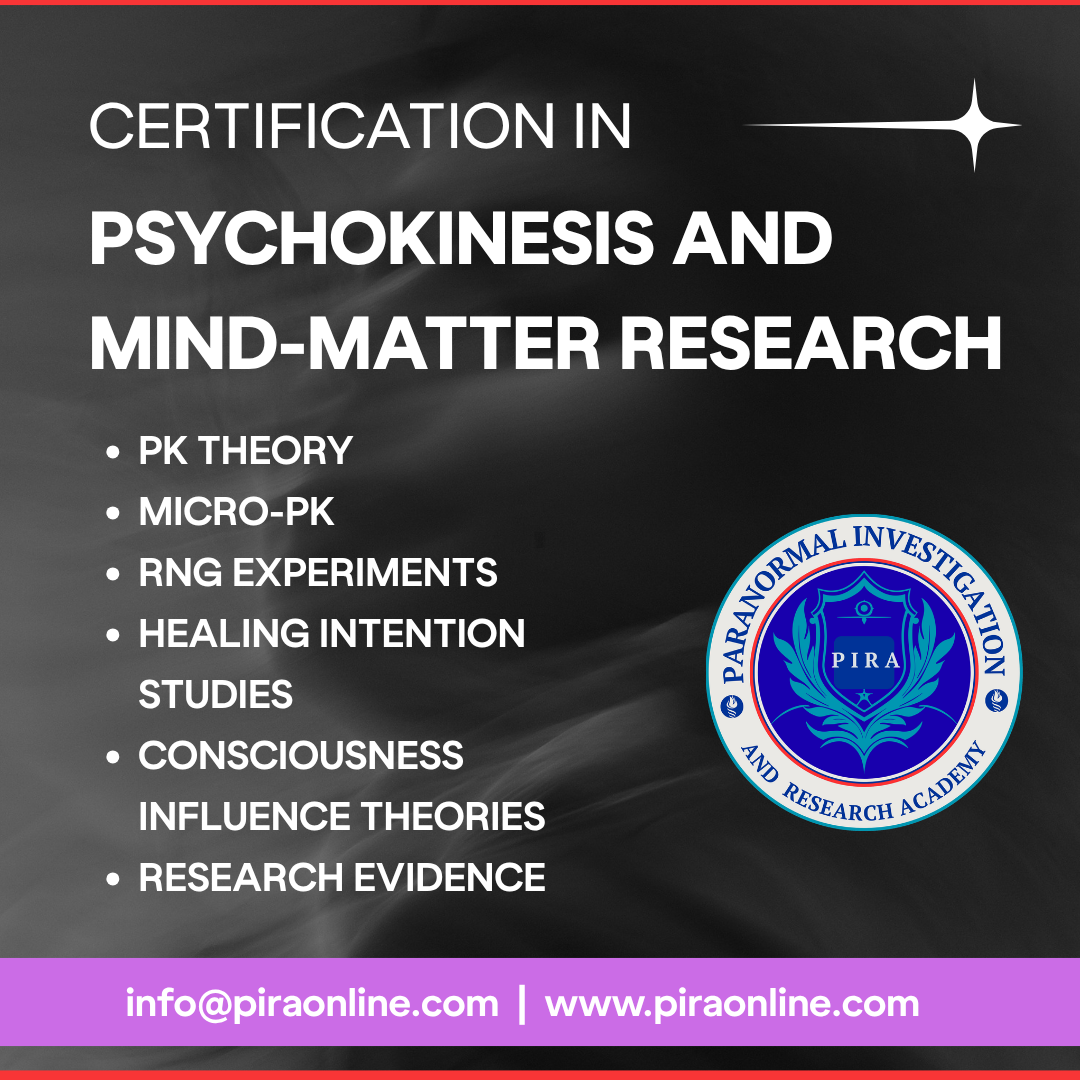
Certificate in Psychokinesis and Mind-Matter Research
Explore Psychokinesis, Consciousness, Human Intention, and the Science of Mind–Matter Experiments
Can mental intention influence a physical system? How can researchers investigate claims of psychokinesis? What separates an extraordinary experience from reliable experimental evidence?
These questions have fascinated researchers, philosophers, and people interested in consciousness for generations. Now you can explore them through a structured educational course focused on psychokinesis, micro-psychokinesis, random number generators, intention experiments, biological systems, and mind–matter research.
The Certificate in Psychokinesis and Mind-Matter Research takes a research-oriented approach to one of the most controversial subjects in the study of consciousness.
Instead of promising that you will learn to move objects with your mind, this course teaches you how to investigate claims of mental influence using controlled experiments, accurate recordkeeping, statistical analysis, replication, and critical thinking.
You will explore historical experiments, examine competing theories, study experimental methods, analyze research findings, and learn how to design your own mind–matter research projects.
Whether you are fascinated by telekinesis, curious about consciousness, interested in parapsychology, or eager to understand how extraordinary scientific claims should be evaluated, this course provides a practical foundation for exploring the subject responsibly.
Move beyond belief and disbelief. Learn how to investigate the question.
What Is the Certificate in Psychokinesis and Mind-Matter Research?
Psychokinesis, often abbreviated as PK, refers to the proposed ability of mental intention to influence physical systems without an ordinary physical mechanism.
Popular accounts often associate psychokinesis with moving objects, bending metal, or influencing physical events through thought alone. However, research into the subject has also investigated much smaller effects that would not be visible without statistical measurement.
One area of interest is micro-psychokinesis, which involves proposed deviations in the output of random number generators or other systems that produce random events.
Researchers have also investigated questions involving human intention, electronic systems, biological measurements, group intention, and other possible forms of mind–matter interaction.
The evidence remains contested. Some studies and research reviews have reported statistical effects that their authors consider interesting, while other investigations have produced null findings or raised questions about publication bias, methodological limitations, and reproducibility.
This makes the subject particularly valuable for learning how research works.
In this course, you will examine psychokinesis as a research hypothesis rather than an established human ability. You will learn how to formulate testable questions, establish appropriate controls, interpret statistical findings, evaluate alternative explanations, and determine what conclusions the available evidence can reasonably support.
The objective is to develop your ability to investigate extraordinary claims with curiosity, methodological discipline, and intellectual honesty.
What Makes This Course Different?
A research-oriented approach to psychokinesis
Explore psychokinesis and mind–matter interaction through experimental concepts rather than relying entirely on dramatic demonstrations, personal stories, or unsupported claims.
Practical experimental design
Learn how to structure experiments involving random number generators, concealed targets, physical objects, intention conditions, and other systems that can be measured and compared.
Statistical thinking made accessible
Explore important research concepts such as chance expectations, effect sizes, statistical significance, p-values, confidence intervals, Bayesian evidence, and multiple comparisons.
You will learn why an interesting result does not automatically establish that an extraordinary explanation is correct.
Understanding both positive and negative findings
Examine the importance of null results, failed replications, conflicting studies, publication bias, and independent verification.
You will learn why scientific conclusions should reflect the complete body of relevant evidence rather than only the studies that support a preferred belief.
Exploring competing theories
Investigate proposed relationships between consciousness, intention, information, physical systems, measurement, and randomness.
You will also learn to distinguish speculative interpretations from established scientific principles, especially when quantum mechanics is discussed in connection with psychic phenomena.
Research skills you can apply independently
Develop a research notebook, construct hypotheses, plan experiments, organize data, identify methodological weaknesses, and prepare balanced research reports.
The emphasis is on learning how to investigate questions systematically, not on guaranteeing a particular outcome.
What Will You Learn?
By completing the course, you will develop an educational foundation in:
- The meaning and historical development of psychokinesis and mind–matter interaction.
- The differences between macro-PK and micro-PK research.
- The role of intention, attention, visualization, motivation, and participant expectations in experimental design.
- The history of physical-object experiments and electronic random-event research.
- Random number generators and their use in experimental investigations.
- Designing pilot experiments with baseline, experimental, and control conditions.
- Recording raw data and maintaining a transparent research logbook.
- Understanding statistical variation and expected chance outcomes.
- Interpreting effect sizes, p-values, confidence intervals, and Bayesian evidence at an introductory level.
- Avoiding selective reporting, multiple-testing problems, and changes to analysis methods after results are known.
- Investigating possible participant, mental-state, and environmental variables.
- Comparing consciousness-related and information-based theories of mind–matter interaction.
- Evaluating research involving biological systems and healing-intention hypotheses.
- Controlling physical variables in experiments involving objects and mechanical systems.
- Understanding replication, reproducibility, and the importance of independent verification.
- Evaluating positive findings, null results, meta-analyses, and conflicting evidence.
- Designing a complete research protocol and preparing a balanced final report.
Complete Course Curriculum
The course progresses from foundational concepts to experimental design, statistical evaluation, research controversies, and the development of a complete mind–matter research project.
Introduction — Understanding Psychokinesis and Mind–Matter Research
Begin by understanding what psychokinesis means and why researchers have investigated the proposed relationship between mental intention and physical systems.
You will explore macro-PK, which concerns claims involving observable physical effects, and micro-PK, which focuses on possible statistical deviations in random or probabilistic systems.
The introduction examines random number generators, electronic noise, random-event systems, biological measurements, individual intention, group intention, and healing-intention research.
You will also investigate why PK research presents significant methodological challenges, including small reported effects, inconsistent replication, statistical fluctuations, expectation effects, publication bias, and the possibility of equipment problems or unintended information leakage.
The module establishes an important research principle: neither belief nor disbelief should replace a testable hypothesis and a careful examination of results.
Practical activity: Create your personal Mind–Matter Research Logbook, including research questions, hypotheses, equipment, experiment dates, raw data, analysis methods, unexpected observations, failed experiments, replication attempts, and final conclusions.
Module 1 — Foundations of Psychokinesis Theory
Establish the conceptual framework needed to investigate psychokinesis claims.
You will explore terminology such as psychokinesis, PK, telekinesis, mental influence, mind–matter interaction, macro-PK, and micro-PK. You will learn why precise definitions matter and how a broad claim can be converted into a specific experimental question.
The module compares proposed physical effects, such as object movement, with statistical effects involving random-event systems.
You will also examine the proposed relationship between intention, mental state, target systems, and measurable outcomes. Competing explanations—including chance, equipment problems, experimenter bias, participant expectations, statistical error, and data-selection effects—will be considered.
Practical assignment: Write an operational definition of psychokinesis, formulate a directional hypothesis, a null hypothesis, and a replication hypothesis, then design a hypothetical PK experiment.
Module 2 — The History and Evolution of Mind–Matter Experiments
Explore how approaches to investigating psychokinesis have changed over time.
You will examine early experiments involving dice, mechanical devices, physical targets, and chance-based outcomes. These historical approaches provide an opportunity to consider the challenges of manual recording, limited trial numbers, experimenter influence, and inconsistent controls.
The module then explores the transition toward electronic systems, which can provide automated recording, precise timestamps, large datasets, and more standardized procedures.
You will also study the Princeton Engineering Anomalies Research tradition as a historical case study involving random-event generators and human intention.
The course introduces meta-analysis and explains how researchers combine findings from multiple experiments while considering effect size, study quality, heterogeneity, and publication bias.
A 2006 meta-analysis of 380 RNG studies reported a statistically significant but extremely small overall effect and identified publication bias as a possible explanation. This provides an important example of why statistical findings must be interpreted alongside methodological limitations.
Practical activity: Create a research timeline covering early chance experiments, electronic RNG studies, laboratory databases, meta-analyses, large online studies, Bayesian analysis, and modern replication approaches. Evaluate three historical experiments for their methodological strengths and weaknesses.
Module 3 — Micro-Psychokinesis and Random Number Generators
Discover how researchers investigate proposed mind–matter effects that may be too small to observe directly.
You will learn the basic concepts of randomness, expected distributions, statistical deviations, trial counts, effect sizes, and significance.
The module introduces different random-number generation approaches, including pseudorandom algorithms, hardware random number generators, quantum-based random generators, electronic noise, and random-event systems.
You will learn why generating random data and correctly analyzing that data are separate technical tasks.
The practical focus is on designing an experiment with clearly defined target conditions, a baseline, a randomization procedure, participant instructions, a stopping rule, and a data-recording plan.
You will also explore comparisons between intentional, neutral, and control conditions without assuming that any observed deviation is evidence of psychokinesis.
Practical assignment: Conduct or simulate an appropriately scoped pilot study, document technical problems and deviations from the plan, and prepare a complete RNG micro-PK pilot report. Any experiment should distinguish genuine hardware randomness from algorithmically generated data and should not present ordinary random fluctuations as proof of mental influence.
Module 4 — RNG Experimental Design and Statistical Analysis
Learn how to design experiments that produce interpretable results rather than simply interesting-looking numbers.
You will explore the importance of establishing baseline behavior and examining properties such as the mean, variance, distribution, and other appropriate statistical characteristics of an RNG dataset.
The module explains experimental conditions, control conditions, and checks designed to determine whether the analysis process itself can generate misleading results.
You will also examine common research problems, including changing hypotheses after seeing the data, removing unfavorable trials, switching statistical tests, stopping when a result becomes significant, and reporting only successful sessions.
Key statistical concepts include probability, standard deviation, z-scores, p-values, confidence intervals, effect sizes, Bayesian evidence, and multiple comparisons.
The emphasis is on understanding what these measures can tell you—and what they cannot establish.
Practical project: Analyze a provided or self-generated RNG dataset and report the original hypothesis, number of trials, expected outcome, observed outcome, statistical method, effect size where appropriate, limitations, alternative explanations, and whether further replication is justified.
Module 5 — Experimental Variables and Conditions That May Influence PK
Move beyond asking whether an effect exists and begin examining the conditions under which a reported effect might appear stronger or weaker.
You will explore participant-related variables such as experience, motivation, belief, concentration, fatigue, stress, emotional state, and training.
Environmental variables—including noise, temperature, lighting, electromagnetic conditions, time of day, distractions, location, and experimenter presence—will also be considered.
The module introduces possible mental-state conditions such as focused attention, relaxation, meditation, visualization, emotional arousal, neutral observation, and divided attention.
You will learn to document these variables consistently and avoid treating a correlation as proof of causation.
A standardized intention scale can be used to record a participant’s subjective effort and compare those ratings with experimental outcomes. Such a scale measures reported intention, not psychic influence itself.
Practical project: Design a controlled experiment that examines one possible moderator of RNG performance, with predefined conditions, appropriate controls, and a clear analysis plan.
Module 6 — Consciousness, Intention and Mind–Matter Interaction Theories
Explore the theories proposed to explain how consciousness and physical systems might relate to one another.
You will examine questions involving conscious intention, attention, observation, measurement, information, randomness, and physical outcomes.
An important part of this module is distinguishing ordinary scientific uses of the term observation from the much stronger claim that consciousness itself causes a physical change.
You will also study quantum-based interpretations of mind–matter interaction, including concepts such as measurement, probability, and superposition. The course emphasizes that quantum mechanics does not automatically establish psychic influence, and quantum terminology alone cannot demonstrate a consciousness-based mechanism.
Information-based models involving entropy, feedback, system organization, and randomness are also introduced as conceptual frameworks to compare.
Practical assignment: Select a proposed theory and compare it with a competing explanation. Identify each theory’s assumptions, predictions, testability, required evidence, possible falsification, limitations, and experimental implications.
Module 7 — Intention Experiments and Biological Systems
Expand your understanding of mind–matter research beyond electronic randomness.
This module examines the possibility of investigating reported relationships between intention and measurable biological outcomes. Potential research subjects discussed include plant responses, cell cultures, microorganisms, enzyme activity, and physiological measurements.
You will explore healing-intention research while distinguishing remote-intention hypotheses from ordinary physical intervention, psychological support, relaxation, expectancy, and placebo-related effects.
The module introduces important experimental design concepts, including experimental and control groups, randomization, blinding, predefined outcome measures, preregistration, and data analysis plans.
You will also compare subjective outcomes, such as perceived wellbeing or relaxation, with objective measurements such as heart rate, blood pressure, and appropriate laboratory biomarkers.
Ethical boundaries are central. Research involving people requires appropriate consent, privacy protections, and any necessary ethics review. Experimental practices must never be presented as a replacement for medical care or as a guaranteed healing method.
Practical assignment: Prepare a hypothetical double-blind healing-intention research protocol with defined outcomes, suitable controls, ethical safeguards, and a transparent analysis plan.
Module 8 — Macro-PK, Physical Targets and Experimental Controls
Investigate claims involving visible physical effects while learning why demonstrations require careful controls.
You will explore how researchers might investigate physical targets such as dice, lightweight objects, mechanical systems, pendulum systems, and other measurable devices.
The module focuses on identifying ordinary physical influences that could produce movement or change, including air currents, vibration, heat, static electricity, magnetic effects, surface movement, human contact, and equipment instability.
You will learn about blinding, isolation, remote observation, video recording, automated measurements, and independent observers.
The course also considers both deliberate fraud and accidental influence, emphasizing that an experiment should be designed to distinguish a proposed extraordinary effect from ordinary physical mechanisms.
Practical activity: Transform a dramatic telekinesis-style demonstration into a research protocol with a defined target, baseline, control conditions, measurement system, environmental controls, video documentation, predefined analysis, and independent verification.
Module 9 — Replication, Reproducibility and Research Controversies
Understand why replication is essential when investigating controversial and potentially small effects.
You will learn the differences between direct replication, conceptual replication, internal replication, independent replication, and registered replication.
The module examines why results can differ between experiments, including small effect sizes, statistical instability, participant variability, experimenter effects, methodological differences, and publication bias.
You will study the importance of including positive studies, null findings, failed replications, and mixed results in the same evidence assessment.
For example, a large online study involving 12,571 participants, published in 2018, reported strong Bayesian evidence for the null hypothesis in its primary micro-PK analysis. This illustrates why large-scale findings that do not support an effect must be taken seriously alongside earlier positive reports.
You will also examine the file-drawer effect, selective publication, small-study effects, and selective outcome reporting.
Practical assignment: Select an existing PK protocol, identify weaknesses in its design, and write a replication plan that improves its controls, hypotheses, statistical procedures, and transparency.
Module 10 — Research Evidence: How to Evaluate the PK Literature
Develop the skills to read and assess psychokinesis research without automatically accepting or rejecting its conclusions.
You will learn to distinguish personal experiences, uncontrolled demonstrations, case reports, pilot studies, controlled experiments, independent replications, meta-analyses, and systematic reviews.
When examining a research paper, you will learn to ask whether the hypothesis was specified in advance, how many participants and trials were included, whether randomization and blinding were used, which statistical tests were applied, whether negative findings were reported, and whether the analysis was planned before the data were examined.
The module explores how conflicting evidence can be evaluated fairly. Some historical analyses have reported statistical deviations from chance, while other investigations have identified possible publication bias or produced null results.
You will also develop a practical evidence-grading framework, moving from personal experience and uncontrolled demonstrations toward controlled research, independent replication, and convergent evidence from multiple laboratories and methods.
Practical assignment: Select a psychokinesis claim and prepare a balanced research evidence report covering supporting studies, contradictory findings, methodological limitations, replication history, alternative explanations, remaining uncertainty, and recommendations for future research.
Module 11 — Designing and Running a Professional Mind–Matter Research Study
Bring together the knowledge and skills developed throughout the course by planning a complete research study.
You will learn to define a research question, formulate a testable hypothesis, select an appropriate target system, choose a measurement method, establish control conditions, and determine what results would count as evidence against your proposed explanation.
The module’s research workflow emphasizes transparent planning, appropriate randomization and blinding, predefined analysis, careful data collection, ethical considerations, and documentation of any changes to the original protocol.
You will also learn to organize research records, examine limitations, and prepare a report that communicates both the findings and the uncertainty surrounding them.
The objective is to develop a research plan that another person could understand, evaluate, and potentially reproduce.
Practical project: Prepare a complete mind–matter research proposal with a clear hypothesis, methodology, controls, data-recording plan, statistical analysis strategy, limitations, and replication plan.
Note: The supplied table of contents ends at the beginning of Module 11 and does not include the remaining lesson headings or the twelfth module’s title. The final two modules should be added using their original outlines when available, rather than inventing unconfirmed course content.
Your Practical Research Portfolio
Throughout the course, you will develop a collection of research documents and exercises that demonstrate your understanding of experimental investigation.
Your portfolio may include:
- A personal Mind–Matter Research Logbook.
- Operational definitions and testable hypotheses.
- A historical timeline of psychokinesis research.
- An RNG micro-PK pilot report.
- A baseline and control-condition design.
- A statistical analysis report.
- A study of possible participant or environmental variables.
- A comparison of competing consciousness-related theories.
- A hypothetical biological intention-study protocol.
- A controlled macro-PK demonstration plan.
- A replication protocol for an existing experiment.
- A balanced review of published evidence.
- A complete mind–matter research proposal.
These activities emphasize the process of research: defining questions, recording observations, checking results, identifying weaknesses, and explaining what can reasonably be concluded.
A successful learning experience does not depend on producing a positive PK result. A carefully documented null result or an experiment that reveals a weakness in the method can be educationally valuable.
Who Is This Course For?
People fascinated by telekinesis and psychokinesis
Explore the subject beyond popular demonstrations and learn how claims of mental influence can be investigated systematically.
Students interested in parapsychology
Develop an educational foundation in PK terminology, historical research, experimental methods, and evidence evaluation.
Consciousness and mind–matter enthusiasts
Examine questions about intention, awareness, randomness, and physical systems while distinguishing established scientific principles from speculative interpretations.
Aspiring independent researchers
Learn how to develop hypotheses, plan experiments, record data, evaluate alternative explanations, and communicate findings transparently.
Critical thinkers and skeptical investigators
Investigate extraordinary claims using the same methodological standards regardless of whether a result appears to support or challenge a particular belief.
Science and research enthusiasts
Explore introductory statistical concepts, replication, research bias, and the interpretation of conflicting findings through a highly specific and unusual subject area.
Educators and content creators
Build subject knowledge that may support educational writing, introductory presentations, or further study of parapsychology and experimental research.
No previous professional research experience is required, although an interest in careful observation, structured learning, and evidence evaluation will be helpful.
How This Certificate Can Support Your Future Interests
Completing this course can provide a foundation for further learning and projects related to psychokinesis, parapsychology, consciousness studies, and experimental investigation.
Depending on your existing qualifications, experience, and future education, you may use the knowledge gained to support activities such as:
- Conducting informal, carefully documented educational experiments.
- Developing introductory educational content about PK research and scientific methodology.
- Preparing literature reviews of mind–matter studies.
- Learning to interpret basic statistical findings.
- Designing research proposals for further study.
- Exploring additional education in psychology, statistics, research methods, consciousness studies, or related fields.
- Creating workshops that teach critical thinking and responsible evaluation of extraordinary claims.
This certificate is an educational credential, not a university degree, government license, or independent scientific accreditation. It does not by itself qualify a student to conduct regulated research or provide clinical, medical, or therapeutic services.
It also does not guarantee employment, income, scientific recognition, or the development of psychokinetic abilities.
Frequently Asked Questions
Does this course teach me to move objects with my mind?
The course explores psychokinesis and telekinesis claims, including proposed macro-PK effects involving physical objects. However, it does not promise that you will acquire the ability to move objects through thought. Its main focus is learning how such claims can be investigated and evaluated.
Is psychokinesis scientifically proven?
Psychokinesis remains a contested research topic. Some studies and meta-analyses have reported statistical effects, while other studies have produced null findings and researchers have raised concerns about publication bias, methodological limitations, and reproducibility. The course teaches you to evaluate the evidence rather than treat the question as already settled.
What is micro-psychokinesis?
Micro-psychokinesis refers to proposed small-scale influences on random or probabilistic systems, often investigated using random number generators or random-event generators. Because the proposed effects are statistical rather than necessarily visible, experimental design and data analysis are especially important.
Do I need advanced mathematics?
No advanced mathematical background is assumed by the course outline. You will explore introductory statistical concepts, including chance expectations, probability, p-values, confidence intervals, effect sizes, and Bayesian evidence. The goal is to understand their meaning and limitations rather than become an advanced statistician.
Will I conduct experiments?
The curriculum includes pilot studies, RNG experiments, target-based exercises, data analysis, and the design of hypothetical protocols. The precise practical work will depend on your available equipment and the course’s supplied resources. Some activities can use existing datasets or simulated data, while other investigations may require suitable equipment and carefully controlled conditions.
Why does the course include unsuccessful experiments?
Because a trustworthy investigation must record all relevant outcomes. Recording only successful attempts can create a misleading impression of performance. Null findings, missed targets, technical problems, and failed replications are important parts of the research process.
Does the course explain quantum physics and psychic influence?
It introduces selected quantum concepts and consciousness-related interpretations as part of the history of proposed explanations. It also emphasizes that quantum mechanics does not automatically establish that consciousness can influence physical systems through psychic means.
Does this course cover healing?
Yes, it introduces healing-intention research as a subject for methodological study. It focuses on experimental design, controls, outcome measurements, and ethical safeguards. It does not teach or certify students to provide medical treatment, and it does not promise healing effects.
Is the certificate a professional scientific qualification?
No. It is an educational certificate in psychokinesis and mind–matter research. It can document completion of the course, but it is not a substitute for a university qualification, professional research training, or any required institutional or regulatory authorization.
Who can benefit from the course if PK is not demonstrated?
The research skills are useful in their own right. You can learn to construct hypotheses, organize data, understand statistical uncertainty, identify bias, assess published evidence, and communicate conclusions responsibly. These skills are valuable for exploring many extraordinary claims, whether or not the proposed effect is supported.
Begin Your Study of Psychokinesis and Mind–Matter Research
Questions about the relationship between consciousness and the physical world continue to inspire debate, investigation, and curiosity.
The strongest way to explore these questions is not to begin with a predetermined answer. It is to define the question clearly, establish a method, record the results, investigate alternative explanations, and determine whether the findings can be reproduced.
The Certificate in Psychokinesis and Mind-Matter Research offers a structured educational journey through the concepts, experiments, theories, and controversies surrounding this unusual field.
Develop your research skills. Examine the evidence. Understand the limitations. Learn to design better experiments.
Enroll in the Certificate in Psychokinesis and Mind-Matter Research and begin exploring extraordinary claims through systematic investigation and critical thinking.
Educational disclaimer: Psychokinesis and related mind–matter claims remain scientifically contested. This course examines proposed effects and research methods for educational purposes; it does not establish that psychokinetic abilities exist or promise that students will develop them. The course is not a substitute for formal scientific training, medical advice, or professional research authorization.

Reviews
There are no reviews yet.