
Description
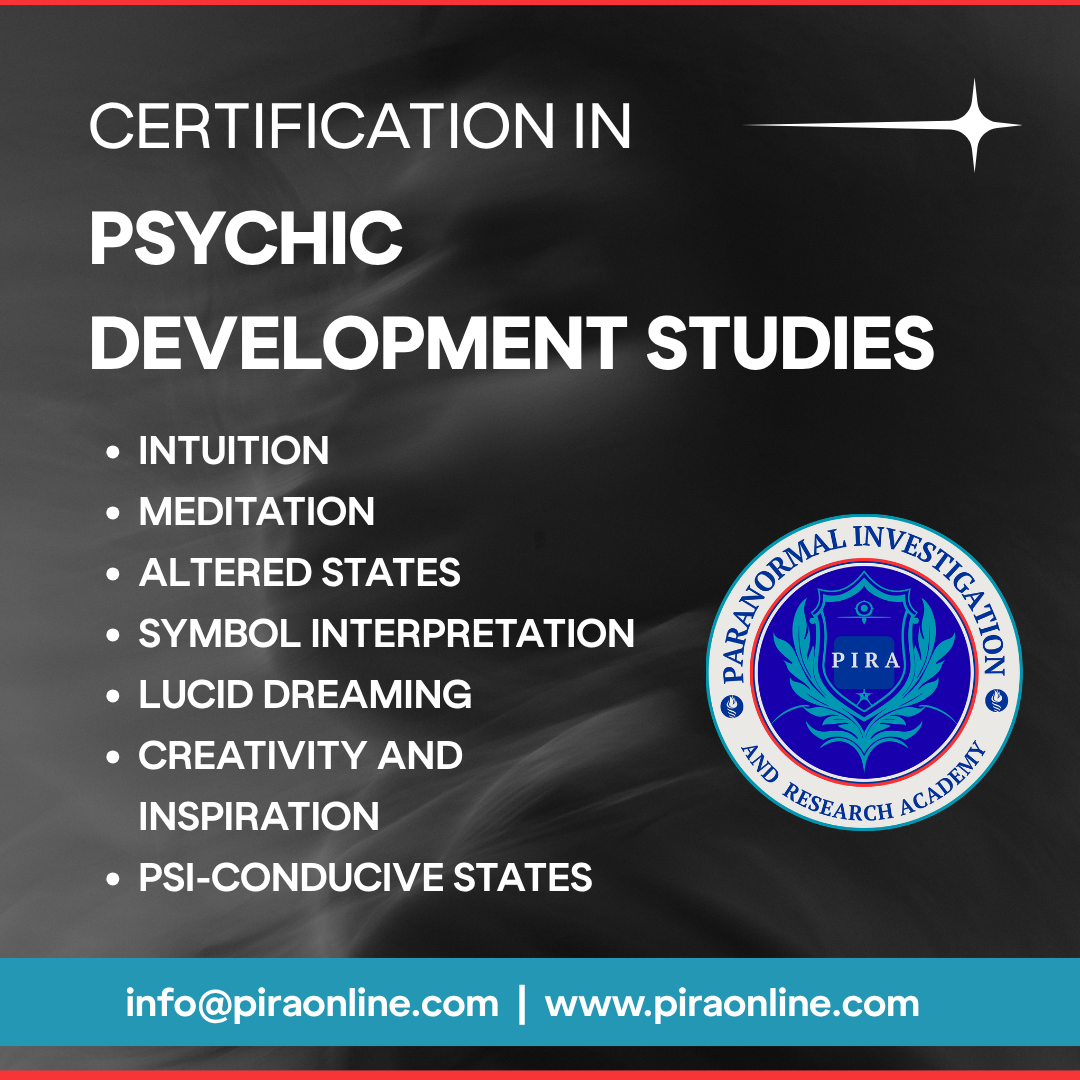
Certificate in Psychic Development Studies
Explore Intuition, Consciousness, Meditation, Dreams, and the Science of Unusual Experiences
Discover a structured approach to psychic development through practical exercises, intuitive experiments, meditation, visualization, dream exploration, symbolic interpretation, and personal consciousness research.
Have you ever experienced a sudden feeling that seemed to tell you something before you could explain it? Have you wondered whether intuition can be developed, whether dreams can reveal meaningful patterns, or whether changes in consciousness can influence the way you perceive the world?
The Certificate in Psychic Development Studies offers an opportunity to explore these questions through a structured, practical learning experience.
Rather than relying entirely on psychic claims, guesswork, or untested beliefs, this course introduces you to methods for observing your experiences, practicing specific techniques, recording impressions, testing predictions, and evaluating your results.
You will explore traditional psychic development practices alongside concepts from psychology, consciousness studies, meditation, sleep research, creativity, and experimental investigation.
Whether you are interested in developing your intuition, exploring your dreams, understanding unusual experiences, or conducting your own experiments, this course provides a framework for turning curiosity into a disciplined personal practice.
Learn to explore unusual experiences with an open mind, a practical method, and a commitment to honest observation.
What Is the Certificate in Psychic Development Studies?
Psychic development is commonly associated with practices intended to explore intuition, extrasensory perception, unusual impressions, and other experiences that some people interpret as psychic.
However, unusual experiences can have different possible explanations. An intuitive feeling might reflect unconscious pattern recognition, prior knowledge, emotional responses, coincidence, or an explanation that requires further investigation. A vivid dream may feel meaningful without necessarily predicting an external event.
This course encourages you to explore these possibilities rather than automatically accepting or dismissing them.
You will learn to develop your attention, recognize spontaneous impressions, practice meditation, strengthen mental imagery, explore lucid dreaming, interpret personal symbols, and conduct structured experiments involving concealed targets and predictions.
You will also learn how to document both successful and unsuccessful attempts, compare your results against appropriate expectations, and identify situations where bias or inaccurate memory could influence your conclusions.
The objective is not to promise supernatural powers. It is to provide a practical educational foundation for studying the experiences, techniques, and questions commonly associated with psychic development.
What Makes This Course Different?
Practical exercises instead of theory alone
You will be introduced to activities that can be practiced at home, including attention exercises, intuition predictions, meditation sessions, visualization tasks, dream journaling, symbol interpretation, and structured target experiments.
A systematic approach to intuition
Instead of relying on vague feelings or memories of successful guesses, you will learn to record your first impressions, assign confidence levels, establish outcomes, and evaluate your performance over repeated trials.
Exploration of consciousness
Discover how attention, relaxation, meditation, dreaming, absorption, and other states of awareness can influence your subjective experiences and mental imagery.
A personal development journal
Build a record of your progress using observation logs, dream records, prediction journals, meditation notes, and experimental results. This helps you identify patterns without depending entirely on memory.
Open-minded but critical investigation
Explore ideas associated with psychic development while learning to distinguish personal experience, interpretation, hypothesis, and evidence. You will be encouraged to follow the results rather than begin with a fixed conclusion.
A personalized practice routine
By working through the course exercises, you can develop a routine suited to your interests, schedule, current experience, and personal development goals.
What Will You Learn?
By the end of the course, you will have explored practical methods for:
- Understanding the meaning of psychic development and its different interpretations.
- Improving attention, concentration, and awareness of internal and external experiences.
- Recognizing spontaneous impressions and distinguishing them from deliberate reasoning, imagination, anxiety, and expectation.
- Developing a structured intuition prediction journal.
- Testing intuitive predictions and calculating basic accuracy rates.
- Practicing concentration and open-awareness meditation.
- Observing changes in awareness associated with relaxation, dreaming, and other non-ordinary states.
- Developing visual, auditory, spatial, emotional, and symbolic mental imagery.
- Interpreting personal symbols without relying entirely on fixed meanings.
- Improving dream recall and exploring lucid dreaming techniques.
- Recording and evaluating claims of meaningful or precognitive dreams.
- Exploring experimental approaches associated with dream telepathy and psi research.
- Investigating the relationship between consciousness, relaxation, creativity, and inspiration.
- Practicing forced-choice and free-response target experiments.
- Understanding randomization, blinding, predefined scoring, and alternative explanations.
- Tracking your development through repeated exercises and personal records.
- Building a more consistent and reflective approach to unusual experiences.
Complete Course Curriculum
The course begins with the foundations of psychic development and gradually introduces more advanced methods of self-observation, experimentation, and personal research.
Introduction — Entering the Study of Psychic Development
Begin by understanding what psychic development means within the course and how it relates to intuition, imagination, meditation, dreaming, altered states, symbolic thinking, creativity, and psi-related experiences.
You will learn the difference between experiencing something, interpreting it, believing an explanation, proposing a hypothesis, and gathering evidence.
You will also explore the importance of patience, consistent practice, accurate recordkeeping, and psychological wellbeing.
Your practical starting activity: Create a Psychic Development Baseline Profile covering your current intuition confidence, meditation experience, dream recall, visualization ability, symbolic interpretation, creativity, bodily awareness, unusual experiences, beliefs, and personal goals. You can repeat this assessment at the end of the course to reflect on your progress.
Module 1 — Foundations of Psychic Development
Establish a clear foundation for your personal development practice.
Learn to approach psychic development as a process of observation, skill-building, reflection, and experimentation rather than simply waiting for unusual experiences to occur.
You will explore attention, awareness, intuition, mental imagery, pattern recognition, emotional sensitivity, dream awareness, concentration, and reflective thinking.
The module introduces an essential distinction between an experience and the meaning assigned to it. You will learn to record an observation, consider possible interpretations, and identify alternative explanations.
You will also establish a personal development journal, design a suitable practice environment, conduct an introductory awareness session, and set short-term, medium-term, and long-term development goals.
Practical activities include: A Three-Column Experience Log, a controlled awareness session, and a personalized development plan.
Module 2 — Training Attention and Inner Awareness
Develop the ability to notice your experiences more carefully before interpreting them.
This module introduces attention exercises involving breathing, sounds, bodily sensations, thoughts, objects, and environmental details. You will practice observing internal signals such as tension, emotional reactions, spontaneous thoughts, and mental imagery without automatically labeling them as psychic.
You will also learn to observe external details, identify the difference between direct observation and interpretation, and record spontaneous impressions for later review.
The goal is to establish a repeatable approach: notice, record, compare, and evaluate.
Practical activities include: The Five-Minute Attention Ladder, detailed object observation, spontaneous impression recording, and a seven-day awareness challenge.
Module 3 — Developing Intuition
Explore how intuitive impressions may appear and how to investigate them through structured practice.
You will examine experiences described as sudden knowing, mental imagery, emotional impressions, bodily sensations, spontaneous verbal thoughts, and rapid pattern recognition.
The module distinguishes random guessing from informed guessing, emotional preference, unconscious pattern recognition, and impressions that seem to arise spontaneously.
You will learn to maintain an intuition prediction journal containing the original question, initial impression, confidence level, possible alternatives, outcome, accuracy, and later interpretation.
You will also practice low-risk prediction exercises using concealed objects, randomly selected images, card colors, envelopes, and other targets.
Practical activities include: Twenty forced-choice predictions, a structured intuition journal, and basic calculations of accuracy and confidence.
Module 4 — Meditation as a Development Tool
Discover how meditation can help you observe attention, thoughts, sensations, and subjective states more systematically.
You will learn to establish a realistic meditation routine and explore concentration techniques such as breath counting, object observation, sound concentration, mantra repetition, and single-word focus.
The module also introduces open-awareness meditation, in which you observe thoughts, memories, emotions, sounds, and sensations without immediately following them.
You will then explore how to compare intuitive task performance following meditation with performance under ordinary conditions. This allows you to investigate your own results rather than assume meditation automatically improves intuition.
Practical activities include: Concentration meditation, open-awareness practice, post-meditation prediction exercises, and a personalized fourteen-day meditation protocol.
Module 5 — Altered States of Consciousness
Explore the different ways human awareness can be experienced.
This module introduces ordinary waking awareness, relaxation, absorption, hypnagogic experiences, dreaming, lucid dreaming, deep meditation, flow, and contemplative states.
You will learn to observe changes in time perception, mental imagery, bodily awareness, attention, thought speed, emotional intensity, and your sense of self.
You will also explore hypnagogic awareness, the transitional period between wakefulness and sleep, and learn to record images, sounds, words, and fragmented thoughts without forcing an experience to occur.
The course emphasizes safer, non-drug approaches to exploring awareness and does not require dangerous sleep deprivation, hyperventilation, or unsupervised substance use.
Practical activities include: Relaxation-based observation, sleep-transition recording, and an Altered-State Log for comparing different experiences.
Module 6 — Developing Visualization and Mental Imagery
Explore imagination as a practical tool for concentration, creative thinking, and personal experimentation.
You will learn about different forms of mental imagery, including visual, auditory, kinesthetic, spatial, emotional, and symbolic imagery.
The module introduces visualization exercises involving shapes, numbers, familiar objects, rooms, landscapes, and moving objects. You will learn to compare what you imagined with an actual target rather than judging your visualization solely by how vivid it felt.
You will also explore multisensory visualization and structured exercises in which a target image is selected randomly and described before it is revealed.
Practical activities include: Visualization accuracy exercises, multisensory mental imagery, target description, and feedback-based improvement.
Module 7 — Symbol Interpretation
Learn how symbols can connect with personal memories, emotions, cultural associations, dreams, and imagination.
Rather than treating every symbol as having one universal meaning, you will develop a personal symbol dictionary that records your first impressions, emotional reactions, associations, cultural meanings, dream appearances, and later interpretations.
You will practice interpreting random images, abstract shapes, inkblot-style patterns, photographs, objects, and dream symbols.
The module encourages you to distinguish what you actually observed from what you think it represents. You will consider multiple interpretations and examine whether later information supports any of them.
Practical activities include: Building a personal symbol dictionary, interpreting unfamiliar images, and creating symbol maps using context, emotion, association, and outcome.
Module 8 — Lucid Dream Development
Discover lucid dreaming and explore practical methods for improving dream awareness.
Lucid dreaming occurs when a person becomes aware that they are dreaming while the dream is still happening. It provides an interesting area for exploring awareness, imagination, memory, and subjective experience during sleep.
You will learn to improve dream recall, recognize recurring dream signs, and use reality-testing techniques to question whether an experience is occurring in a dream.
The module also introduces approaches such as mnemonic intention, visualization before sleep, dream journaling, reality testing, and wake-back-to-bed strategies.
Once lucidity occurs, you can explore dream environments, observe spontaneous imagery, practice creative activities, and record experiences after waking.
Practical activities include: A bedside dream journal, personalized dream-sign identification, reality testing, and structured lucid-dream attempts.
Module 9 — Dream Symbolism and Dream Psi Exploration
Take your dream records further by exploring recurring patterns, emotional themes, unusual details, and claims that dreams may correspond with future events or information beyond ordinary awareness.
You will learn how to document dreams accurately, identify recurring locations and characters, and record specific details before learning about a possible matching event.
The module explains why dates, original descriptions, specific predictions, and careful comparisons matter when investigating claims of precognitive dreaming.
You will also explore controlled partner exercises associated with dream-telepathy research. One participant selects a target image while another records dreams or impressions without seeing the target. The records can then be compared using an agreed scoring method.
These exercises are opportunities to investigate reported experiences, not proof that dreams provide information through psychic means.
Practical activities include: Advanced dream journaling, recurring-pattern analysis, partner target experiments, and a fourteen-to-thirty-day dream research portfolio.
Module 10 — Psi-Conducive States
Investigate the idea that some conditions of awareness may be useful for studying experiences traditionally associated with extrasensory perception.
You will examine relaxation, meditation, absorption, hypnagogia, dreaming, flow, deep concentration, and sensory-reduction approaches such as Ganzfeld-inspired exploration.
The module focuses on how to prepare for an experiment, record impressions consistently, and compare results obtained under different conditions.
You will learn to establish a standardized sequence involving preparation, attention stabilization, target presentation, impression recording, feedback, and evaluation.
Rather than assuming one state is superior, you will compare your observations across conditions and consider alternative explanations.
Practical activities include: State preparation, safe sensory-awareness exercises, comparisons between ordinary and post-meditation conditions, and the design of a personal psi-state protocol.
Module 11 — Creativity, Inspiration and Non-Ordinary Thinking
Explore how relaxation, daydreaming, dreams, meditation, free association, and periods of reduced deliberate effort may contribute to creative thinking.
You will investigate the relationship between consciousness and inspiration while learning practical techniques for generating and developing ideas.
Exercises include automatic writing, free drawing, rapid idea generation, random-word association, image association, and music-inspired visualization.
You will also learn to use dream material as a starting point for stories, artwork, poetry, product concepts, and personal projects.
The module introduces incubation experiments in which you define a problem, work on it briefly, take a break, and record ideas that emerge afterward. You will then evaluate those ideas for usefulness rather than assuming that every spontaneous thought is accurate or meaningful.
Practical activities include: Dream-based creativity, problem incubation, free-association exercises, and a daily ten-minute inspiration protocol.
Module 12 — Advanced Intuitive and Psi Experiments
Move from informal impressions to more structured experimentation.
You will explore forced-choice tasks using cards, numbers, symbols, images, and randomly selected targets. You will also learn about free-response tasks in which you describe impressions without choosing from a fixed list of answers.
The module introduces remote-viewing-style practice, where a participant records impressions about an unknown target before the target is revealed.
You will study why randomization, blinding, separation of target information, predefined scoring, independent judging, and complete records can help reduce bias.
You will also learn to evaluate the results of your experiments by examining total trials, hits, misses, expected chance performance, confidence, experimental conditions, and possible sources of error.
Practical activities include: Forced-choice trials, free-response descriptions, remote-viewing-style exercises, and personal results analysis.
Module 13 — Advanced Self-Experimentation and Development Tracking
Learn how to organize your development practice into a more systematic process.
This module focuses on turning questions into testable personal experiments. You will explore how to formulate a question, establish a hypothesis, choose a method, conduct trials, record results, and analyze the findings.
You will also develop a more organized approach to tracking progress across different exercises and conditions. Rather than relying on memorable experiences alone, you can build a record of attempts, outcomes, confidence levels, and observations.
The aim is to make your personal development practice more consistent, transparent, and open to improvement.
Practical focus: Experiment planning, structured recordkeeping, and reviewing progress through documented results rather than impressions alone.
Modules 14 and 15 — Continuing Your Advanced Development Practice
The supplied curriculum ends during Module 13.1, so the detailed titles and lesson descriptions for Modules 14 and 15 have not been provided here. The course overview nevertheless establishes a fifteen-module program. The final sales page should include the original titles and learning objectives for these two modules when their outlines are available, rather than inventing lessons or presenting unconfirmed content as part of the curriculum.
Your Practical Learning Experience
This course is designed around active participation. You are encouraged to build a personal collection of records and experiments as you progress.
Depending on your interests, your practice may include:
- A personal Psychic Development Baseline Profile.
- Daily attention and observation records.
- A structured intuition prediction journal.
- Meditation session records and comparisons.
- An altered-state observation log.
- Visualization and target-description exercises.
- A personal symbol dictionary.
- A dream recall and lucid-dream journal.
- Records of dream-related target experiments.
- Creativity and inspiration exercises.
- Forced-choice and free-response experiment results.
- A personal development portfolio documenting your methods, observations, and conclusions.
These activities help you build a repeatable approach to exploring your experiences. You do not need to experience anything unusual or achieve a particular prediction score to benefit from learning how to observe and evaluate your results.
Who Is This Course For?
The Certificate in Psychic Development Studies may be suitable for:
People interested in psychic development: Explore the practices and ideas commonly associated with intuition, psi, and unusual perception in a structured learning environment.
Beginners exploring intuition: Learn how to record intuitive impressions, test predictions, and distinguish spontaneous feelings from assumptions or expectations.
Meditation and consciousness enthusiasts: Explore attention, relaxation, absorption, visualization, and other subjective states through practical exercises.
Dream and lucid-dream enthusiasts: Develop dream recall, recognize recurring patterns, and explore techniques for becoming aware during dreams.
Students interested in parapsychology: Learn about experimental approaches used to investigate claims involving extrasensory perception and related experiences.
Creative individuals: Explore visualization, dream-based inspiration, free association, and incubation as ways to generate and develop ideas.
Writers, artists, and researchers of unusual experiences: Build a more organized approach to recording subjective experiences and investigating their possible meanings.
Personal development enthusiasts: Create a consistent practice centered on attention, reflection, journaling, and measurable personal goals.
No previous experience with psychic development is required. The course is intended for educational exploration and does not require students to accept a particular belief about psychic phenomena.
How This Certificate Can Support Your Future Interests
Completing the course can provide a foundation for further personal study and educational projects related to intuition, consciousness, dreams, meditation, creativity, and parapsychology.
Depending on your existing skills, additional education, experience, and local requirements, you might use what you learn to support activities such as:
- Developing a personal meditation and dream-journaling practice.
- Creating educational content about intuition and consciousness.
- Conducting informal, carefully documented personal experiments.
- Exploring further study in parapsychology and consciousness research.
- Developing workshops or introductory learning materials about observation, journaling, and reflective practice.
- Creating creative projects inspired by dreams, symbolism, and visualization.
This certificate is an educational credential. It does not, by itself, establish scientific expertise, professional licensure, or authorization to provide regulated psychological, medical, or therapeutic services. It also does not guarantee employment, business income, or particular psychic abilities.
Frequently Asked Questions
Do I need previous experience to join?
No. The course begins with the foundations of psychic development and progresses toward more structured exercises. Beginners can start with the introductory assessments and build their practice gradually.
Will this course teach me how to become psychic?
The course explores techniques and experiences traditionally associated with psychic development, including intuition exercises, visualization, meditation, dream exploration, and psi-related experiments. However, it does not promise that you will acquire supernatural abilities. Your results may vary, and unusual experiences should be evaluated carefully.
Is the course based entirely on supernatural beliefs?
No. It combines practical exploration of traditionally psychic practices with critical observation, psychological explanations, consciousness-related concepts, and basic experimental methods. You can explore the subject without being required to accept a particular conclusion.
Will I learn to develop my intuition?
You will practice recording spontaneous impressions, making predictions, tracking confidence, reviewing outcomes, and comparing performance across repeated trials. These activities can help you understand your own intuitive judgments and how reliably they perform under different conditions.
Will I learn meditation and visualization techniques?
Yes. The curriculum includes concentration meditation, open-awareness meditation, visualization, multisensory imagery, and exercises for comparing imagined targets with actual targets.
Does the course cover dreams and lucid dreaming?
Yes. You will explore dream recall, recurring dream signs, reality testing, lucid-dream induction approaches, dream symbolism, and methods for documenting claims of precognitive dreams or dream-related target matching.
Are the experiments difficult to perform?
Many activities are designed for individual practice or simple partner exercises. They can be adapted to your available time and resources. More structured experiments require careful recordkeeping, randomization, and appropriate separation of target information.
What if my experiments are unsuccessful?
Unsuccessful attempts are part of the learning process. The course encourages you to record misses as carefully as hits, avoid changing predictions after seeing the outcome, and consider whether chance, expectation, memory, or other factors could explain a result.
Is this a qualification in psychology or therapy?
No. This is an educational certificate in psychic development studies. It is not a psychology degree, clinical qualification, or license to diagnose or treat mental health conditions.
Does the certificate guarantee professional opportunities?
No certificate can guarantee employment, income, or business success. The course can support further learning and the development of personal projects, but professional opportunities depend on your wider skills, experience, local requirements, and the services you choose to offer.
Do I need to believe in psychic phenomena?
No. The course is suitable for people who are curious, skeptical, undecided, or interested in exploring the subject from different perspectives. The emphasis is on observation, practice, documentation, and thoughtful evaluation.
Begin Your Journey into Psychic Development Studies
Intuition, dreams, meditation, mental imagery, and unusual experiences raise fascinating questions about how we perceive and interpret the world.
The most useful way to explore these questions is to combine curiosity with a method: practice regularly, record what happens, test your impressions, and remain willing to reconsider your explanations.
The Certificate in Psychic Development Studies provides a structured starting point for this journey, helping you move beyond vague impressions toward a more organized and reflective exploration of consciousness and experiences associated with psychic development.
Enroll today and begin building your personal practice in intuition, meditation, visualization, dream exploration, and structured self-experimentation.
Explore the experiences. Record the observations. Test the impressions. Learn from the results.
Certificate in Psychic Development Studies — A Practical Educational Journey into Intuition, Consciousness, and Unusual Experiences.
Educational disclaimer: This course explores subjective experiences and practices associated with psychic development. Claims of extrasensory perception and other paranormal abilities remain scientifically disputed and should not be presented as established facts. The course is for educational and personal-development purposes and is not a substitute for medical, psychological, or professional advice.
Reviews
There are no reviews yet.